
Appliance Hauling: A Practical Guide for Homeowners
That dead refrigerator in the garage. The washer that stopped spinning three months ago. The oven you replaced but never moved out. They’re heavy, awkward, and impossible to ignore once you’ve decided they need to go.
Appliance hauling sounds simple enough. Get the old thing out of the house, put it on a truck, take it somewhere. But if you’ve ever tried to move a full-size refrigerator down a flight of stairs or wrestled a washing machine through a doorway, you already know: it’s not a one-person job, and it’s not as straightforward as it looks.
Most homeowners have no idea how appliance hauling actually works, what it costs, or what options exist beyond “call someone and hope for the best.” This guide is here to fix that.
What Is Appliance Hauling?
Appliance hauling is the process of removing large, heavy household appliances from your home and transporting them to the appropriate destination, whether that’s a recycling facility, a donation center, a scrap yard, or a landfill. It covers everything from the physical removal (getting the appliance out of your house without destroying your walls) to the logistics of responsible disposal.
Unlike regular junk removal, appliances come with specific challenges. Many are too heavy for one or two people to safely carry. Some contain refrigerants, mercury, or compressor oils that are regulated by federal law. Others are connected to gas lines, water supply, or dedicated electrical circuits that need to be properly disconnected before anything moves.
It’s one of those services that seems unnecessary until you’re standing in your kitchen staring at a 300-pound refrigerator with no plan.
When You Need Appliance Hauling
Some situations make the need obvious. Others sneak up on you.
01 Upgrading to new appliances
The delivery crew drops off the new refrigerator, and suddenly the old one needs to go. Some retailers offer haul-away with delivery, but many don’t, or they charge extra and require the old unit to be disconnected and ready.
02 Renovating a kitchen, laundry room, or bathroom
Contractors need the space clear before they can work. Old appliances sitting in the middle of a renovation create delays and safety hazards.
03 Moving to a new home
Not everything is worth taking with you. Older appliances that are heavy, outdated, or unreliable are often better left behind, but they still need to be removed before the sale closes or the lease ends.
04 Estate cleanouts
A property that hasn’t been updated in decades can have multiple appliances that need removal, each with different disposal requirements. This is often one piece of a larger cleanout process.
05 An appliance breaks down
When a repair costs more than a replacement, hauling the dead unit away is the next step. But a broken appliance that’s been sitting in the garage for months doesn’t get lighter with time.
06 Clearing out a rental property
Tenants leave, and sometimes appliances are left behind or need replacing. Landlords and property managers often schedule appliance hauling as part of a turnover.
You might be wondering whether you should just handle it yourself. Sometimes that works. But if the appliance is large, on an upper floor, still connected, or contains hazardous materials, professional hauling is the safer and faster path. We’ll break down when DIY makes sense and when it doesn’t later in this guide.
What Appliances Can Be Hauled Away
Most appliance hauling companies will take the full range of major household appliances. Here’s what that typically includes.
Refrigerators, freezers, stoves, ovens, ranges, dishwashers, trash compactors, wine coolers, and microwaves (including over-the-range units).
Washers and dryers, both top-load and front-load. These are often removed as a pair, which usually means better pricing per unit.
Water heaters (gas and electric), water softeners, furnaces, boilers, portable and window air conditioning units, dehumidifiers, and space heaters.
Chest freezers, standalone ice makers, commercial-grade appliances from home kitchens, and even built-in units like wall ovens or cooktops, though these may require additional labor for extraction.
Toasters, blenders, coffee makers, and other countertop appliances are usually accepted too. They take up minimal space on the truck, and most haulers will take them alongside a larger pickup.
What most companies won’t take:
Appliances with active pest infestations, units that have been exposed to floodwater or sewage, or anything with visible mold contamination. Some companies also have restrictions around gas-connected appliances that haven’t been properly disconnected. Always confirm with the hauler before they arrive.
How Appliance Hauling Works
The process is more straightforward than most people expect. Here’s what a typical appliance hauling job looks like from start to finish.
01 You reach out for a quote
Call, fill out an online form, or text a photo of what you need removed. Most companies will give you a rough price based on the type and number of appliances. Some offer flat-rate pricing per item. Others quote based on truck space.
02 The crew arrives and assesses the job
They’ll look at the appliance, check the access path (stairs, narrow hallways, tight corners), and confirm the final price before they start. A good company locks the quote after this walkthrough. No surprises at the end.
03 Disconnection, if needed
If the appliance is still hooked up to water, gas, or electricity, the crew will typically handle basic disconnections. For gas lines, some companies require a licensed plumber or gas technician to disconnect the unit first. Ask about this when you book.
04 Removal and loading
The crew uses dollies, straps, and floor protection to get the appliance out of your home and onto the truck. This is where experience matters. A crew that does this daily knows how to angle a side-by-side refrigerator through a 32-inch doorway without gouging your trim.
05 Disposal, recycling, or donation
Once the appliance is on the truck, the crew takes it to the appropriate facility. Working appliances in good condition may be donated. Recyclable units go to certified recyclers. Everything else goes to the proper disposal site. Responsible haulers keep as much out of the landfill as possible.
06 Done. Your space is clear
The whole process, from crew arrival to clean space, typically takes 30 minutes to an hour for a standard pickup of one to three appliances.
Appliance Hauling Cost: What to Expect
What drives the price up or down:
Ways to save:
Your Disposal Options
Getting the appliance out of your house is only half the equation. Where it goes afterward matters, both for the environment and, in some cases, for your wallet.| Option | Cost | Convenience | Best For |
| Professional hauling |
| High | Heavy, broken, or hazardous appliances |
| Retailer haul-away | $25–$50 (or free with purchase) | High | Replacing one appliance |
| Municipal pickup | Free to $50 | Medium | Usually Budget-conscious, flexible timeline |
| Scrap yard/recycler | Free (may even pay you) | Low | DIY-capable with a truck |
| EPA RAD program | Often free | Medium | Refrigerant-containing appliances |
| Donation | Free | Medium | Working appliances in good condition |
| Sell/give away | Free (or earn money) | Low | Working appliances, flexible timeline |
How to Prepare Your Appliances for Pickup
Appliances aren’t ordinary junk. Many contain materials that require careful handling, and federal and local regulations dictate how they must be disposed of.
01 Empty the appliance completely
Remove all food from refrigerators and freezers. Clear dishes from dishwashers. Take clothes out of washers and dryers. Sounds obvious, but haulers see full refrigerators more often than you’d expect.
02 Unplug and disconnect
If you’re comfortable doing so, unplug the appliance and disconnect it from water supply lines. For gas appliances (stoves, dryers, water heaters), call the hauling company first. Many require a licensed professional to disconnect gas lines before removal. Don’t attempt this yourself unless you know exactly what you’re doing.
03 Defrost if needed
Refrigerators and freezers should be unplugged at least 24 hours before pickup to allow ice to melt. Place towels around the base to catch water. A defrosted unit is lighter and won’t leak all over your floor during removal.
04 Clear the path
Move furniture, boxes, rugs, and anything else that might be in the way between the appliance and the nearest exit. The crew needs a clear, wide path to move a heavy unit safely. Tight turns, stairs, and narrow hallways are manageable, but obstacles in the path slow things down and increase the risk of damage.
05 Secure loose parts
Tape refrigerator doors shut. Coil and secure power cords and hoses with zip ties or tape. Remove any detachable shelves or racks. Loose parts can swing open during transport and damage walls or injure the crew.
06 Know what you’re getting rid of
Before the crew arrives, have a clear list of which appliances are going and which are staying. If multiple people are involved in the decision (family members, co-owners, tenants), get alignment ahead of time. Changing your mind mid-removal creates delays and can affect pricing.
Environmental and Safety Considerations
A little prep before the crew arrives makes the whole process faster, cheaper, and smoother. Here’s what to do.
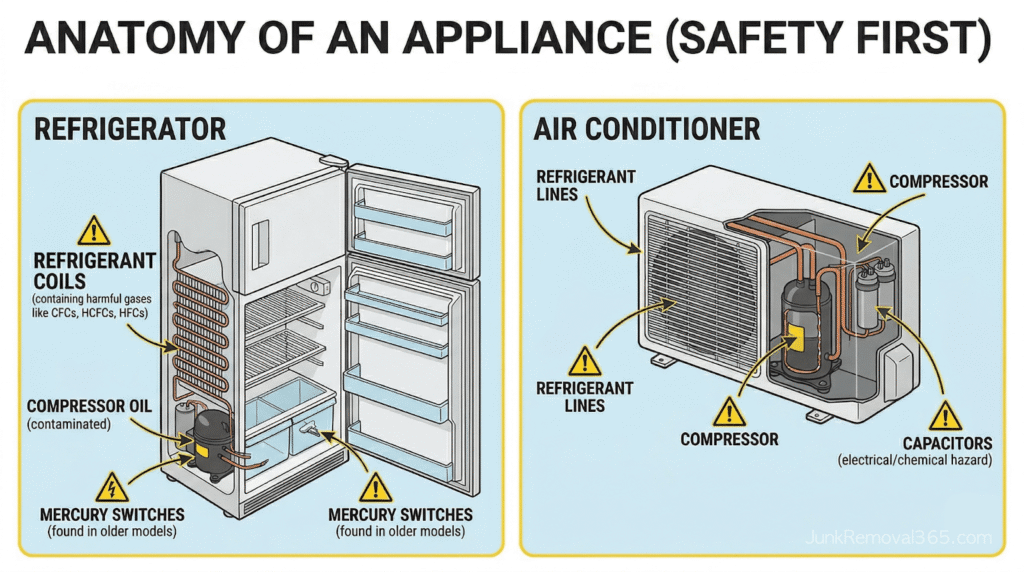
Refrigerants
Refrigerators, freezers, air conditioners, and dehumidifiers contain refrigerant gases (historically CFCs and HCFCs, now primarily HFCs). These are ozone-depleting or greenhouse gas substances that must be recovered by a certified technician before the appliance can be recycled or scrapped. The EPA requires this under the Clean Air Act. Venting refrigerant into the atmosphere is illegal and carries significant fines.
Mercury
Older appliances, particularly chest freezers and some washing machines, may contain mercury switches. These require special handling during disposal.
Compressor oil and PCBs
Refrigerators and freezers contain oil in their compressors that must be drained and disposed of properly. Older units (pre-1979) may also contain polychlorinated biphenyls (PCBs), a hazardous substance regulated under federal law.
Lead and other heavy metals
Some older CRT displays on appliances, solder in electronic components, and certain paints may contain lead. Responsible recyclers separate and handle these materials appropriately.
DIY vs. Professional Appliance Hauling
DIY works when:
✓ The appliance is small or lightweight (countertop microwave, window AC)
✓ You have a truck or trailer and a friend to help
✓ It’s on the ground floor with easy door access
✓ You have a destination lined up (scrap yard, recycling center)
✓ It does not contain refrigerant requiring professional recovery
Professional Makes Sense When:
✓ The appliance weighs over 150 pounds
✓ It’s on an upper floor, in a basement, or behind a tight corner
✓ It’s still connected to gas, water, or hardwired electrical
✓ It contains refrigerant (refrigerator, freezer, AC, dehumidifier)
✓ You’re removing multiple appliances at once
✓ You value your back, your floors, and your Saturday
The real cost of DIY:
Even when you own a truck, the hidden costs add up. Dump fees range from $20 to $75 depending on your area. Recycling facilities may charge a drop-off fee. The time investment, from loading to driving to waiting in line at the disposal site, can easily eat half a day. And the injury risk is real. A 350-pound refrigerator on a ramp is not something to improvise.
How to Choose an Appliance Hauling Company
Not all haulers are the same. Some are full-service junk removal companies that handle appliances alongside everything else. Others specialize in appliance pickup and recycling. Both can do the job well. Here’s what to look for.
01 Upfront, transparent pricing
The company should be willing to give you a clear estimate before showing up. Once they assess the job on-site, the final price should be locked in before any work begins. No surprises at the end.
02 Proper licensing and insurance
This protects you if something goes wrong during the removal. Ask whether the crew is insured for property damage and injuries. A company that can’t answer this question clearly isn’t one you want inside your home.
03 Responsible disposal practices
Ask where the appliances go after pickup. Do they recycle? Donate working units? Partner with certified recyclers for refrigerant recovery? A company that cares about this will be happy to tell you. One that doesn’t will change the subject.
04 Reviews and reputation
Check Google reviews, Yelp, and the Better Business Bureau. Look for patterns in feedback, especially around pricing accuracy, punctuality, and professionalism. A few negative reviews are normal. A pattern of complaints about hidden fees or no-shows is a warning sign.
05 Scheduling flexibility
The best companies offer same-day or next-day service when possible. They communicate clearly about arrival windows and give you a heads-up when the crew is on the way.
06 Crew quality
This is harder to evaluate upfront, but you’ll notice it immediately. A good crew introduces themselves, walks the job before starting, confirms the price, protects your floors, and treats your home with respect. That’s the baseline, not the exception.
Red Flags to Watch For
Frequently Asked Questions About Appliance Hauling
How much does it cost to have an appliance hauled away?
For a single large appliance, expect to pay between $75 and $200, with $100 being a common average. Pricing depends on the type and weight of the appliance, its location in your home, disconnection requirements, and local disposal fees. Multiple appliances on the same pickup usually bring the per-item cost down.
Do I need to disconnect my appliance before hauling?
For electric appliances, simply unplugging is usually sufficient. For appliances connected to water lines (dishwashers, washing machines, water heaters), you can often shut off the valve and disconnect the hose yourself. For gas-connected appliances (gas stoves, gas dryers, gas water heaters), many hauling companies require a licensed professional to handle the disconnection before they’ll remove the unit. Always ask when you schedule the pickup.
Will the hauling company take my appliance from inside the house?
Most full-service appliance hauling companies will remove the unit from wherever it sits in your home, including basements, upper floors, and tight spaces. Some companies only offer curbside pickup (usually at a lower price). Clarify which service you’re booking.
Can I put old appliances in a dumpster?
In most areas, yes, with some exceptions. Refrigerant-containing appliances (refrigerators, freezers, AC units) typically require refrigerant recovery before they can go in a dumpster. Some landfills also have restrictions on appliances with sealed compressors. Check with the dumpster rental company and your local disposal facility before tossing an appliance in.
What happens to my appliance after it’s hauled away?
Responsible hauling companies sort appliances based on condition and material. Working units in good shape may be donated to local charities. Non-working appliances are taken to certified recyclers where metals, plastics, and other materials are separated and processed. Refrigerant is recovered and handled according to EPA regulations. Only materials that can’t be recycled end up in a landfill.
Does my city offer free appliance pickup?
Many municipalities provide free or low-cost bulk-item pickup for residents, including large appliances. Availability, scheduling, and requirements vary by city. Some require appliances to be placed at the curb. Others require refrigerant to be removed beforehand. Contact your local waste management department or check your city’s website for details.
Is it worth trying to sell my old appliance instead?
If the appliance is less than 10 years old and in good working condition, selling is worth considering. Platforms like Facebook Marketplace, Craigslist, and Nextdoor make it easy to list items locally. Keep in mind that selling takes time: listing, coordinating with buyers, and waiting for pickup. If you need the appliance gone quickly, professional hauling or donation is usually the faster path.
Can I get a tax deduction for donating my old appliance?
If you donate a working appliance to a qualified nonprofit organization, you may be able to claim a tax deduction for the fair market value of the item. Ask the charity for a donation receipt at the time of pickup. Consult a tax professional for specifics on what qualifies and how to document it.