
Hoarding Cleanups: Safety, Costs, and What Actually Works
Hoarding cleanup is not the same as junk removal, deep cleaning, or decluttering. It’s a process that sits at the intersection of mental health, physical safety, housing stability, and human dignity. And when it’s handled poorly, the consequences can be serious — damaged trust, worsening hoarding behavior, health risks, legal trouble, or even permanent family rifts.
Most guides about hoarding cleanup focus on logistics: trash bags, dumpsters, timelines, and “tough love.” They rarely explain why hoarding happens, when cleanup becomes dangerous, or how to make progress without causing emotional harm or relapse.
This guide exists because those gaps matter. A hoarded home can involve fire hazards, mold, pests, biohazards, structural damage, and extreme emotional distress. Treating that situation like a normal cleanup doesn’t just fail — it often makes things worse.
Who This Guide Is For
Hoarding cleanup looks very different depending on why you’re here. The emotional weight, urgency, and safest next step change dramatically based on your role in the situation. Before you think about trash bags or timelines, it’s important to name which perspective you’re coming from — because the wrong approach for your situation can make things worse instead of better.
Person Struggling
You deserve help without humiliation
Family & Friends
Helping without destroying trust
Landloards
Safety, compliance, harm reduction
You may feel ashamed, overwhelmed, or afraid that once cleanup starts, you’ll lose control over your space, or over decisions that feel deeply personal. That fear is understandable.
For many people, hoarding isn’t about the items themselves. It’s about safety, identity, memory, and control. Cleanup can feel like a threat to all of that at once.
You deserve help that doesn’t treat you like a problem to be solved.
If you’re here for someone else, you may be exhausted, frustrated, scared, or angry — often all at once. You might feel trapped between wanting to help and feeling like nothing you do works. Conversations turn into arguments. Cleanup attempts end in shutdowns or blowups. Trust may already feel fragile.
Helping someone with hoarding is emotionally demanding. You’re allowed to protect yourself while still acting with compassion.
You may be facing complaints, inspections, code violations, or pressure from neighbors, while also knowing there’s a real person living inside that space. This puts you in a difficult position.
If This Is Urgent (Inspection, Eviction, or Safety Crisis)
If there’s a looming inspection, eviction notice, or immediate safety concern, you don’t have the luxury of doing everything “the right way.” Right now: Perfection does not matter. Emotional processing can wait. Only safety and compliance matter.
No matter why you’re here, one principle applies to everyone: You don’t have to fix everything today. The goal of hoarding cleanup is not a perfect home. It’s a safer one, achieved without causing more harm than help.
What Hoarding Is (and What It Isn’t)
Hoarding is often misunderstood. To someone walking into a hoarded space, the problem can look obvious: too many items, too little space, and decisions that seem irrational. From the inside, however, hoarding is not about clutter — it’s about distress, avoidance, and protection.
Hoarding disorder is a recognized mental health condition. At its core, it involves persistent difficulty discarding possessions, intense emotional distress when trying to make decisions, and living spaces that lose their intended function over time.
What makes hoarding especially difficult is that the behavior is often driven by care, not neglect. Items become connected to safety, memory, identity, responsibility, or future security. Letting go doesn’t feel neutral — it can feel dangerous, wasteful, or irreversible. That’s why logic alone rarely works.
Hoarding vs Mess vs Collecting
Understanding the difference matters, because the response needs to match the reality.
Why “Just Throw It Away” Backfires: When cleanup is forced or rushed, the result is often panic, shutdown, loss of trust, increased secrecy, and rapid relapse. Items are removed, but the emotional system that created the hoarding remains untouched.
Hoarding Severity Levels
Not all hoarding situations are the same. Two homes can both be described as “hoarded” and still require completely different approaches, timelines, and levels of help. That’s why understanding hoarding severity is critical before you start cleaning.
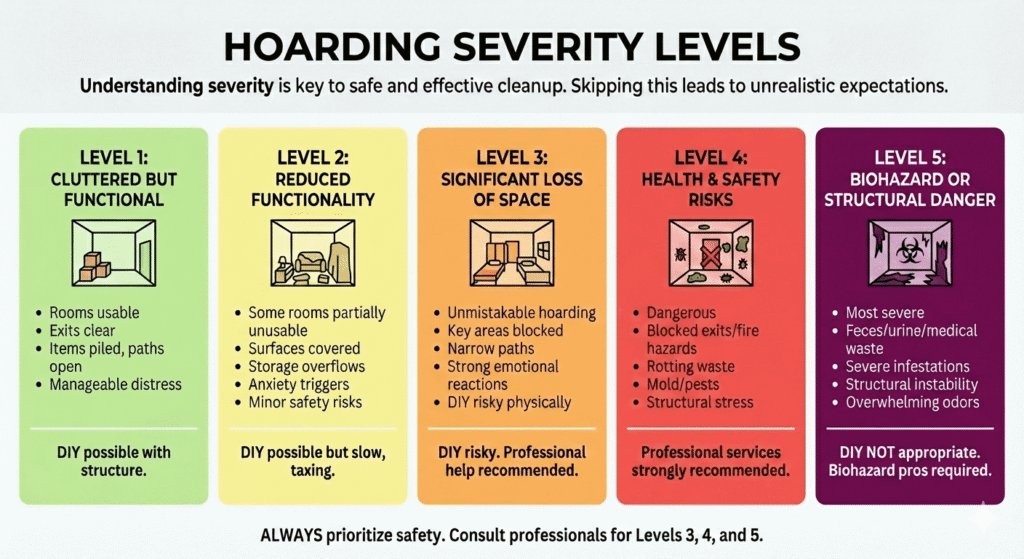
01 Cluttered but Functional
This may look like excessive clutter rather than true hoarding. DIY cleanup is usually possible with a gentle, structured approach and clear boundaries.
02 Reduced Functionality
Safety risks are beginning to appear, but biohazards are typically not present yet. DIY cleanup may still be possible, but progress is slow and emotionally taxing.
03 Significant Loss of Living Space
DIY cleanup becomes risky here. Not just emotionally, but physically. Many people underestimate how exhausting and destabilizing cleanup can be at this level.
04 Health and Safety Risks
Professional hoarding cleanup services are strongly recommended at this stage. Attempting DIY cleanup can expose people to serious health risks or legal consequences.
05 Biohazard or Structural Danger
DIY cleanup is not appropriate at this level. Biohazard remediation and specialized hoarding cleanup professionals are required to ensure safety and compliance.
Why Severity Changes Everything
Misjudging severity is one of the most common reasons hoarding cleanups fail. Starting with a plan meant for Level 1 or 2 when the situation is actually Level 4 or 5 can result in:
Severity isn’t about blame. It’s about choosing the safest and most realistic path forward.Once you understand the severity of the situation, the next step is safety triage — checking whether the space is safe to be in at all before any cleanup begins.
One of the most confusing parts of handling an estate is understanding the difference between an estate cleanout, an estate sale, and working with an estate liquidator. While these options often overlap, they serve very different purposes — and choosing the wrong approach can slow down the entire process
Safety Triage: What to Check Before Cleaning a Hoarder House
Before you pick up a single item, ask one question: Is this space safe to be in right now? This step is non-negotiable. Many hoarding cleanups go wrong because people rush to “start making progress” without realizing they’re standing in a space that poses serious health or safety risks.
Safety triage is about assessment, not action. It usually takes 10–15 minutes and can prevent weeks of setbacks.
• Paper near heaters
• Overloaded outlets
• Rotting food
• Needles or sharps
• Droppings or nests
• Movement in piles
• Leaning piles
• Doors won’t open
DIY may be reasonable if:
✓ No feces, needles, or biohazards
✓ Mold is minimal and on non-porous surfaces
✓ No active infestations
✓ Floors feel stable
✓ Air is breathable
✓ At least one exit path exists
Professional help needed if:
✗ Any biohazards present
✗ Mold is widespread or structural
✗ Pests are active
✗ Floors or ceilings feel unstable
✗ Strong ammonia, sewage, or chemical smells
✗ You feel physically unsafe
The Minimum Viable Safety Outcome: One clear, usable exit path. One functioning bathroom. One safe sleeping area. If those three things exist, you have bought time. Everything else can wait. Tip: Check out the National Fire Protection Association’s guide on fire hazards caused by clutter.
Setting the Cleanup Goal and Scope
One of the fastest ways to derail a hoarding cleanup is to aim too high, too early. When people picture “cleanup,” they often imagine a fully restored home. In hoarding situations, that expectation creates overwhelm, panic, and resistance before real progress even begins.
The solution is to define the right goal, not the biggest one.
The Only Three Valid Cleanup GoalsFocuses on: Clearing exit paths, restoring one bathroom, creating one safe sleeping area, removing immediate hazards. Correct starting point for most severe or urgent situations
Focuses on: Making most rooms usable again, restoring kitchen and bathroom function, creating clear walking paths. Appropriate once safety is under control and trust is intact
Includes: Deep cleaning, repairs or renovations, reorganizing belongings, rebuilding habits. Rarely the first step, often fails when attempted too early
Instead of asking, “How do we fix this?” ask: “If we stopped after one week, what would make this space meaningfully safer and better?”
Examples: A clear hallway from bedroom to exit, a usable toilet and sink, one cleared bed, all rotting food removed.
The Human Side: Consent, Dignity, and Roles
Hoarding cleanup fails more often because of people dynamics than because of logistics. You can have the perfect plan, the right supplies, and plenty of time — and still hit a wall if consent is ignored, roles are unclear, or emotions spiral out of control.
Consent Is Not Optional (Except for Safety)
Whenever possible, nothing should be removed without consent. Consent means the person living in the space knows what is happening, has a say in what is kept or discarded, and is not surprised or betrayed by secret actions.
The only time consent can be overridden is when safety or legal requirements demand it: blocked exits, biohazards, or child or animal endangerment. Even then, transparency matters.
Separate Safety From Sentiment
Not all items are equal, and treating them that way causes unnecessary conflict. Create a clear distinction between:
• Safety items: things that must go (rotting food, feces-soaked items, blocked exits)
• Personal items: things that require choice, time, and emotional processing
Assign Clear Roles Before You Start
Unclear roles lead to arguments, duplicated effort, and emotional overload. Decide roles in advance, even if one person fills more than one. Common roles include:
• Decision-maker: the person whose belongings they are (or a legal decision-maker)
• Safety lead: watches for hazards and stops work if something becomes unsafe
• Runner: takes trash out, moves bags, handles logistics
• Emotional support: notices distress and calls for breaks
Supplies, PPE, and Setup
Hoarding cleanup is physically demanding work. Doing it without the right setup increases the risk of injury, illness, and burnout, and makes emotional overload more likely. You don’t need specialized equipment for every situation, but you do need basic protection, clear organization, and a realistic work rhythm. The Occupational Safety and Health Administration has published a good primer on Personal Protective Equipment.
DIY may be reasonable if:
✓ No feces, needles, or biohazards
✓ Disposable gloves for contaminated items
✓ Closed-toe shoes with good grip
✓ Mask or respirator (dust, mold, odors)
✓ Eye protection if risk of debris
Environment Prep
✓ Open windows and doors if possible
✓ Use fans to improve airflow
✓ Have water and light snacks available
✓ Plan breaks every 45–90 minutes
✓ Set a hard stop time
The Five Sorting Zones
TRASH
Broken, rotten, or unsafe
DONATE
Usable items leaving soon
KEEP
Items staying in home
HAZARD
Requires special handling
UNSURE
Difficult decisions that can wait
The Unsure zone is critical. It allows progress without forcing premature decisions. Stopping while things are still going well is better than pushing to exhaustion.
The Cleanup System That Actually Works
Hoarding cleanup fails when it turns into chaos. Without a clear system, people bounce between rooms, move the same items repeatedly, get stuck in emotional loops, and burn out long before real progress is made.
The 3-Layer Method
Clear exits and paths
Start by clearing walking paths to exits, bathrooms, and key rooms. Do not sort. Do not reminisce. The only goal is safe movement.
Create one safe zone
Choose one room or section and make it fully usable. This becomes a refuge — a place to rest, think, and reset when the rest feels overwhelming.
Expand zone by zone
Only after a safe zone exists do you begin expanding outward, one defined area at a time. Never work in more than one new zone per session.
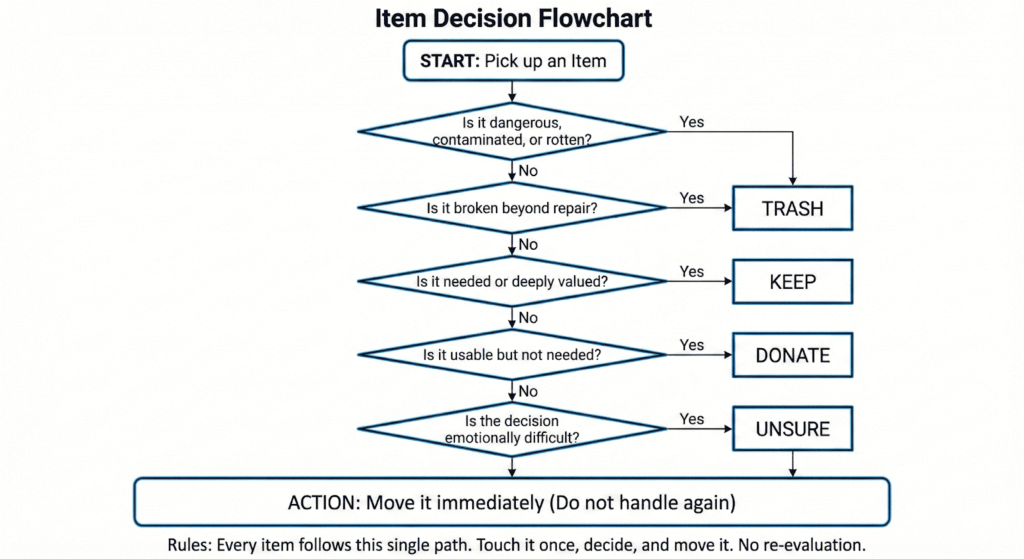
Item Decision Flow
Every item should move through the same decision path. This prevents endless re-evaluation.
Room-by-Room Cleanup Playbooks
Different rooms carry different risks and emotional weight. Treating every space the same leads to poor decisions and unnecessary stress.
These playbooks focus on function first, not perfection. The goal is to restore basic use and safety before worrying about organization or aesthetics.
01 Exits and Hallways (FIRST PRIORITY)
Focus on: Clearing a continuous walking path, removing items blocking exits, eliminating trip hazards.
Do not sort or reminisce here. If an item blocks movement, it moves.
02 Bathrooms
Focus on: Making toilet usable, clearing sink access, ensuring shower/tub is safe to enter.
Discard expired/contaminated products and moldy items. If feces, urine, or severe mold are present, stop and call professionals.
03 Bedroom
Sleep is a form of recovery. Focus on: Clearing the bed completely, creating path from bed to exit, ensuring lighting is accessible.
Avoid sorting personal items here until safety and sleep are restored.
04 Kitchen
Often the most emotionally charged spaces. Focus on: Removing all rotting food, clearing sink and stove, creating one usable food-prep surface.
Do not attempt to organize cabinets or pantries yet. Function comes first.
05 Living Areas
These spaces help restore normalcy. Focus on: Clearing walking paths, making one chair usable, removing obvious hazards
06 Closets, Storage, and Basements (LAST)
These come last. They often contain the most emotionally difficult items and are rarely urgent for safety. Only approach them once trust, stamina, and momentum are established.
Hazard-Specific Protocols (When to Stop DIY)
Knowing when to stop is as important as knowing how to proceed. Continuing DIY cleanup in the presence of serious hazards puts people at risk and often creates legal, medical, or financial consequences.
DIY may be reasonable if mold is limited, on non-porous surfaces, with no strong odor and no one has respiratory sensitivities.
Stop DIY if: Mold covers large areas, is embedded in walls/floors/ceilings, there’s persistent smell, or you experience breathing difficulty. Check out the Centers For Disease Control and Prevention’s guide on mold cleanup basics and health effects.
Human or animal waste can carry bacteria, parasites, and airborne pathogens. Household cleaners and gloves are not sufficient protection.
Stop cleanup and contact biohazard cleanup professionals immediately.
Used needles, lancets, or sharps pose serious injury and infection risk. Do not handle without proper sharps containers. Do not bag loosely.
If needles are present, especially in large numbers, professional handling is required.
Active infestations change the order of operations. Signs include roaches, rats, mice, flies, bedbugs, droppings, nests, or movement within piles.
Cleanup should pause until pest control is involved. Disturbing infested areas spreads pests.
Stop DIY if you notice sagging floors, soft spots underfoot, widening cracks, or piles supporting walls/ceilings.
Removing items acting as unintentional structural support can cause collapse.
Trust Your Body and Instincts: If you feel dizzy, nauseous, short of breath, panicked, or disoriented — stop. No cleanup goal is worth risking health or safety.
Disposal, Donations, and Realistic Costs
One of the most underestimated parts of hoarding cleanup is what happens after items leave the room. Without a clear disposal plan, cleanup slows down, decisions get revisited, and piles quietly migrate from one space to another.
Donations feel good, but they can quietly derail progress. Donating too much slows decision-making, creates new piles, and encourages second-guessing.
Set strict limits: No more than 1–3 donation boxes per session. Items must leave within 24–48 hours. If pickup isn’t scheduled, items default to disposal.
Disposal Options
Realistic Hoarding Cleanup Costs
| Situation | Typical Cost Range |
| Small stabilization cleanup | $500 – $2,000 |
| Apartment hoard (moderate) | $2,000 – $6,000 |
| House hoard (severe) | $5,000 – $20,000+ |
| Biohazard cleanup | $2,000 – $15,000+ |
Factors that increase cost: Biohazards or mold, pest infestations, multiple floors or poor access, tight timelines, required PPE or containment.
Cost vs Consequence: People often delay professional help because of cost, but delay can be more expensive. Unaddressed hoarding can lead to code violations, eviction, health emergencies, structural damage, and higher cleanup costs later.
Hiring Professional Hoarding Cleanup Services
Knowing when to bring in professionals — and choosing the right ones — can make the difference between a cleanup that stabilizes the situation and one that creates new problems. Not all cleanup services are equipped to handle hoarding.
Types of Help Available
Questions to Ask Before Hiring:
✓ How do you handle consent and decision-making?
✓ What hazards are included in your service?
✓ Is disposal included in the price?
✓ What insurance do you carry?
✓ How do you handle items marked “unsure”?
Red Flags to Watch For:
✗ No proof of insurance or licensing
✗ Requires cash-only payment
✗ Refuses to explain their process
✗ Dismisses consent concerns
✗ Won’t provide written scope of work
After Cleanup: Cleaning, Repairs, and Reset
Finishing a hoarding cleanup doesn’t automatically make a home livable. Once clutter and hazards are removed, many spaces still feel unfamiliar, fragile, or emotionally unsettling. This phase is about stabilizing the win — turning an emptied space into something that feels usable, safe, and worth maintaining.
Usually enough when:
• No biohazards present
• Surfaces are intact
• Odors are mild
• Mold was minimal and addressed
Needed when:
• Odors persist after cleaning
• Mold was extensive
• Flooring or drywall was contaminated
• Biohazards were present
Avoid the “All at Once” Trap: This is not the moment to reorganize the entire home, buy new storage systems, or replace everything. Too much change at once can trigger anxiety and regression. Stability comes from small, predictable improvements.
Preventing Relapse (The Part Most Guides Ignore)
Cleanup alone does not solve hoarding. Without changes to daily habits, decision pressure slowly rebuilds. Stress increases, avoidance returns, and clutter creeps back in — often quietly, until the situation feels overwhelming again. Relapse is not a personal failure. It’s a predictable outcome when the underlying conditions stay the same.
Why Relapse Happens
Tiny Daily Habits That Actually Stick
Support Beyond the Cleanup
For many people, outside support is essential:
Progress Over Perfection: Relapse prevention isn’t about never slipping. It’s about noticing sooner, responding gently, and restarting before things escalate. If clutter starts to grow: Pause → Reset one zone → Remove one bag → Recommit to small steps. You don’t need to go back to the beginning.
Special Situations and Edge Cases
Some hoarding cleanups don’t follow the normal rules. Legal pressure, grief, refusal, or vulnerable people in the home can change priorities fast. In these cases, the goal is not an ideal outcome — it’s harm reduction and safety.
Once compliance is achieved, deeper cleanup can happen later.
Sorting sentimental items too early often causes shutdown or regret.
Acceptable interventions: Clearing exits, removing biohazards, protecting children or animals. The goal is containment, not conversion.
Document conditions, seek professional guidance, prioritize visible safety improvements.
Requires coordination between biohazard cleanup, animal welfare organizations, and sometimes local authorities.
FAQs About Hoarding Cleanup
How much does hoarding cleanup cost?
Hoarding cleanup costs typically range from $500 to $20,000+, depending on severity, volume, hazards, access, and timeline. Mild stabilization cleanups may stay under $2,000, while severe hoarding with biohazards or structural risks can exceed $20,000.
Can you clean a hoarder house yourself?
DIY cleanup is sometimes possible in mild to moderate cases where there are no biohazards, infestations, mold, or structural issues. Once feces, needles, severe mold, pests, or unsafe floors are involved, professional cleanup is strongly recommended.
When is professional hoarding cleanup required?
Professional help is necessary when there are biohazards (feces, urine, needles), active infestations, widespread or structural mold, unsafe floors or blocked exits, or legal deadlines or inspections.
Is hoarding a mental illness?
Yes. Hoarding disorder is a recognized mental health condition. It involves difficulty discarding items, emotional distress, and impaired living spaces. Effective cleanup respects this reality rather than treating hoarding as laziness or stubbornness.
Why do forced cleanups often fail?
Forced cleanups remove items but not the emotional system behind the behavior. They often result in panic, loss of trust, secrecy, and rapid relapse. Cleanup works best when safety is prioritized and dignity is preserved.
How long does hoarding cleanup take?
Timelines vary widely. Stabilization can take hours or days. Moderate cleanups may take several days to weeks. Severe cases can take weeks or occur in phases over months, especially when emotional readiness is limited.
Will the hoarding come back?
Relapse is common if habits and stressors don’t change. Prevention depends on small, consistent maintenance routines, reduced incoming clutter, and support when needed. Cleanup is a reset — not a cure.