
The side hustle economy has flooded your market with competitors. Here’s what the data actually shows—and why the smartest operators aren’t panicking.
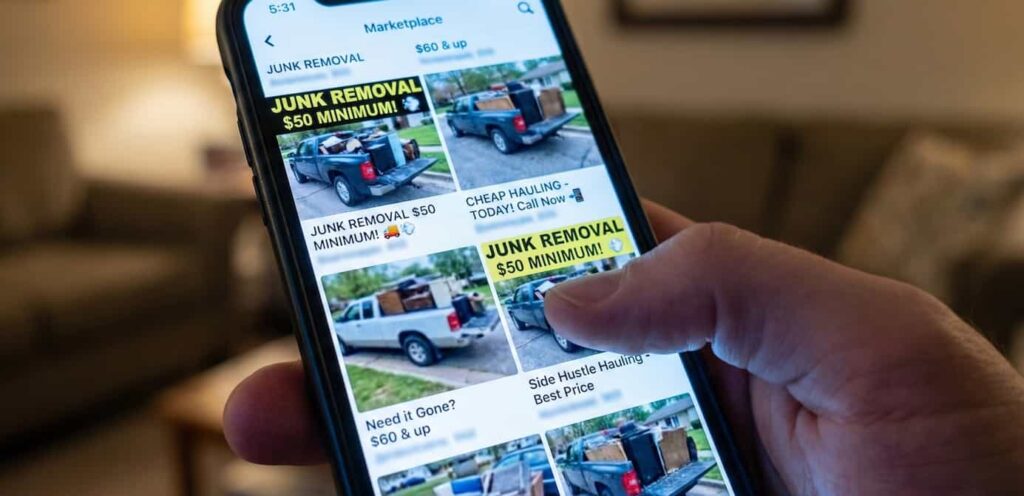
You’re scrolling through Facebook Marketplace and see it again: “JUNK REMOVAL – $50 MINIMUM – SAME DAY – CALL/TEXT” posted by a guy with a profile picture of his pickup truck. Last week there were three of these posts. This week there are twelve.
The junk removal side hustle has exploded. YouTube is filled with “how I made $500 in one weekend hauling junk” videos. TikTok creators brag about “the easiest side hustle with a truck.” And every laid-off worker with an F-150 seems to be hanging up a shingle.
For established operators who’ve built legitimate businesses—invested in trucks, insurance, marketing, employees—this raises an uncomfortable question: Is this flood of part-timers a threat to your livelihood, or an opportunity hiding in plain sight?
The answer, backed by data, is more nuanced than the panic suggests. The side hustle wave is real, it’s not going away, and fighting it is futile. But the smartest operators aren’t wringing their hands. They’re adapting—and in many cases, thriving because of the very trends that seem threatening.
Here’s what’s actually happening, what it means for your business, and how to position yourself to win.
The Side Hustle Explosion: What the Numbers Actually Show
Let’s start with the macro picture, because the junk removal side hustle boom isn’t happening in isolation. It’s part of a fundamental shift in how Americans work.
According to recent surveys, somewhere between 36% and 40% of Americans now have a side hustle. That’s not a typo—roughly four in ten working adults are earning money outside their primary job. The global gig economy was valued at $556.7 billion in 2024 and is projected to hit $2.15 trillion by 2033, growing at over 16% annually.
The numbers on independent work are even more striking. Full-time independent workers—people who’ve made gig work their primary income—more than doubled from 13.6 million in 2020 to 27.7 million in 2024. Over 70 million Americans now participate in some form of freelance or gig work, representing approximately 36% of the total workforce.
The average side hustler earns $885 per month, though the median is just $200—indicating that a small number of high earners pull up the average while most participants make modest supplemental income. About 72% of side hustlers say they do it to supplement their regular income, with financial pressures from inflation cited as a major driver.
Why Junk Removal Specifically?
Junk removal has become a magnet for side hustlers because of its unique characteristics. The barrier to entry is remarkably low. You can start with as little as $1,000 to $4,000—a truck you might already own, some basic tools, gloves, and insurance. No specialized training or certification is required in most areas. You get paid the same day you complete the job, providing immediate cash flow. And the work is flexible enough to fit around a day job or other commitments.
The demand side is equally attractive. Americans generate enormous amounts of waste, and the decluttering trend shows no signs of slowing. The aging population creates steady demand for estate cleanouts and downsizing help. Housing turnover, renovations, and the simple accumulation of stuff keep the phone ringing.
The U.S. junk removal industry generated $10.4 billion in revenue in 2023 and employed approximately 67,000 people, according to IBISWorld. The residential segment alone is projected at $6.1 billion. The junk removal franchise market, while smaller, is growing even faster—from $0.76 billion in 2023 to a projected $2.18 billion by 2032, a compound annual growth rate of 12.5%.
Here’s the number that should catch your attention: there are now over 21,000 registered junk removal companies in the United States, and that count keeps growing. The market remains, in industry parlance, “highly fragmented with no dominant national player controlling more than a small percentage of total market share.”
The Side Hustle to Business Pipeline
Not every side hustler stays a side hustler. Some scale into legitimate operations that become real competitors—or potential acquisition targets.
Consider the McKinney brothers, Kirk and Jacob, who started Junk Teens as a high school side hustle in Boston. In 2021, working with just a pickup truck and renting U-Hauls and dumpsters as needed, they generated $120,000 in revenue. By 2022, they’d added a dump truck and grown to $430,000. In 2023, with two dump trucks and a pickup, they hit $910,000. Their projection for 2024 was $1.2 million, operating three dump trucks.
Their advice to aspiring entrepreneurs: “Keep it simple. People often overcomplicate things. In junk removal, it’s as easy as picking up junk, getting paid, and driving away.”
That trajectory—side hustle to six figures to seven figures in just a few years—is the dream that draws people in. The reality is that most won’t make it that far. Many will stay part-time indefinitely, earning a few hundred dollars a month. Others will burn out within 12 to 18 months, discovering that the work is harder and less glamorous than the YouTube videos suggested.
But some will stick around and grow. And that’s worth paying attention to.
The Legitimate Concerns: Why Operators Worry
Let’s be honest about what established operators are seeing on the ground. The concerns are real, even if the panic is often overblown.
Price Undercutting
The most immediate complaint is about pricing. Side hustlers often charge 30% to 50% less than established operators. They can afford to—they have no overhead, no employees, no insurance premiums, no marketing budget, no office, no dispatch software. A guy with a truck and a Craigslist ad can undercut you all day.
This creates a race-to-the-bottom dynamic, at least in the price-sensitive segment of the market. When customers see “$50 minimum” posts flooding Facebook Marketplace, it recalibrates their expectations. Professional operators charging $150 to $600 for a full truck load suddenly seem expensive by comparison.
The reality is that price shoppers—estimated at 20% to 30% of the residential market—will always choose the cheapest option. They’re not your ideal customer anyway, but losing them still stings.
Market Saturation
The barrier to entry cuts both ways. The same characteristics that make junk removal attractive to you make it attractive to everyone else. Anyone with a pickup truck can technically start a junk removal company, and many have.
According to the Small Business Administration, about 23% of small franchise startups fail within the first two years, often due to high competition. Industry surveys suggest that roughly 31% of small operators face significant difficulties entering the market because of competition and regulatory hurdles.
The marketing landscape has shifted accordingly. Operators who got into digital advertising early remember when Google Ads clicks cost $3 to $4. Today, you’re looking at $10 to $15 or more for similar positioning. More competition means higher customer acquisition costs for everyone.
The sentiment is real. On TikTok, you’ll find creators saying things like: “My opinion on the junk removal business—it’s not what it used to be. It’s oversaturated and you should just do it as a side hustle.”
Reputation Damage to the Industry
This is the concern that should worry everyone, regardless of business model. Unlicensed, uninsured side hustlers are contributing to a growing illegal dumping problem that tarnishes the entire industry.
Seattle spent $2.9 million cleaning up illegal dumping in 2024. The city has seen an 82% increase in large-scale tire dumping since 2022. City officials point to “rising commercial disposal costs, unlicensed haulers, gaps in enforcement, and capacity regulations” as root causes.
Vancouver received approximately 22,000 reports of abandoned garbage and illegal dumping in 2024, with construction materials accounting for 9% of those reports. Industry insiders note that disposal costs have “almost quadrupled” in some areas, creating financial incentives for bad actors to undercut competitors by avoiding proper facilities.
Here’s a statistic that might surprise you: only about 3% of street trash comes from homeless encampments. The rest, according to environmental advocacy groups, comes from fly-by-night haulers who dump waste illegally.
The consequences fall on customers too. When an unlicensed hauler dumps your stuff illegally, you—the customer—can be held liable. Fines range from $250 to $10,000 depending on jurisdiction. In California, illegal dumping can result in up to six months in jail under Penal Code 374.3.
The scenario plays out predictably. A homeowner hires a cheap hauler off Craigslist, pays cash, gets no receipt. Three days later, they get a call from the police. Their junk was found dumped behind a business, and the debris has their name and address on it. The “cheap” option just became very expensive.
Quality and Professionalism Issues
Beyond illegal dumping, side hustlers often can’t deliver the reliability and professionalism that certain customers require. They may have irregular availability since junk removal isn’t their primary business. They often lack the equipment, training, or experience to handle complex jobs. They might not prioritize eco-friendly disposal, proper recycling, or donation of usable items.
For a residential customer doing a one-time garage cleanout, these issues might not matter much. For a property manager who needs reliable service across multiple units, or a contractor who needs construction debris removed on a tight schedule, they’re dealbreakers.
The Hidden Opportunity: What Smart Operators See
Here’s where the conversation shifts. The operators who are thriving right now aren’t the ones complaining about side hustlers. They’re the ones who’ve figured out how to leverage the very trends that seem threatening.
Opportunity #1: The Side Hustler Is Your Future Employee
One of the biggest challenges in scaling a junk removal business is finding reliable labor. Employee turnover rates in the industry run between 45% and 55% annually. Training each new employee to full productivity costs approximately $1,200 and takes three to four weeks. The physical demands and seasonal work patterns make it hard to attract and retain good people.
Side hustlers have already self-selected for this work. They’ve chosen to spend their free time lifting heavy objects, dealing with dirty jobs, and interacting with customers. They understand the basics. They’ve proven they can show up and complete jobs.
Many side hustlers don’t actually want to build a whole business. They want the work and the income, but not:
- the marketing,
- the bookkeeping,
- the customer service headaches,
- the insurance paperwork.
They’d happily trade their feast-or-famine lead flow for steady work with someone else handling the business side.
The opportunity: recruit promising side hustlers as employees or subcontractors. They’re pre-trained, motivated, and often relieved to find a better path than grinding on Craigslist.
Opportunity #2: Overflow and Subcontracting Networks
Junk removal demand is seasonal. You might see swings of 50% or more between peak periods (spring cleaning, summer moving season, post-holiday decluttering) and slow months. During peak times, established operators often turn away work because they can’t handle the volume.
Meanwhile, side hustlers are hungry for jobs and have capacity sitting idle.
Several companies have built entire business models around this reality. LoadUp operates a national network of independent contractors—they call them “Loaders”—who accept jobs through an app. The company handles marketing, quoting, payment, dispatch, and logistics. Contractors focus on completing jobs and get paid weekly.
Grunber positions itself similarly: “We don’t send you leads. We send you real quoted jobs, so you know what you’ll make upfront.” Contractors receive customers in their area without customer acquisition costs.
Pro Junk Dispatch offers “franchise-like support and territories, without franchise costs or obligations.” Side hustlers get the jobs; the platform handles the business infrastructure.
The opportunity for established operators: build your own subcontractor network. Identify reliable side hustlers in your area. Vet them for insurance, reliability, and quality. Offer them overflow work during peak seasons. You maintain the customer relationship, charge your rate, pay the subcontractor a fair amount, and keep the margin. You scale without fixed employee costs, and you never have to turn away work.
Opportunity #3: The Differentiation Gap
Side hustlers can compete on price. They cannot compete on everything else.
Think about what a licensed, insured, professional operation offers that a guy with a truck cannot:
- Insurance and licensing protect the customer. If something gets damaged, if someone gets hurt, there’s coverage. There’s accountability. There’s recourse.
- Consistent availability and scheduling mean customers can book in advance, get specific time windows, and trust that someone will actually show up.
- Professional appearance—branded trucks, uniformed crews, a real website—signals credibility and trust.
- Eco-friendly disposal with documentation matters to customers who care about where their stuff ends up. Many professional operators track and report their diversion rates, partner with donation centers, and provide receipts showing proper disposal.
- Commercial and specialty services—hoarding cleanouts, estate liquidations, construction debris, hazardous materials—require expertise, equipment, and certifications that side hustlers simply don’t have.
- Recurring service relationships are impossible to build when you’re working Craigslist. Professional operators can offer property managers, storage facilities, and commercial clients ongoing contracts with volume discounts.
The opportunity: double down on everything side hustlers can’t or won’t do. Make your professionalism visible. Display your insurance and licensing prominently. Build a Google Business Profile with 100+ reviews. Get listed on industry directories like JunkRemoval365 that help customers identify legitimate operators. Invest in the assets that compound over time rather than competing for the scraps.
Opportunity #4: The Premium Customer Segment
Who are side hustlers actually serving? Mostly price-sensitive residential customers doing small, one-time jobs. People who don’t particularly care about insurance or licensing. People willing to take the risk for a lower price.
Who are they not serving well?
Commercial clients represent roughly 30% of the junk removal market. They need reliability, insurance documentation, proper invoicing, and accountability. A side hustler showing up in a personal truck with no paperwork doesn’t cut it.
Property managers account for about 12% of service demand. They need volume discounts, recurring schedules, fast turnaround on unit turnovers, and a single point of contact for multiple properties.
Contractors and builders represent approximately 18% of customers. They need rapid response, OSHA-compliant operations, and the capacity to handle large volumes of construction debris on tight timelines.
Then there’s the network of referral partners—realtors, estate attorneys, senior move managers—who need to recommend someone they can trust with their clients. Their reputation is on the line. They’re not sending their best client to a Craigslist random.
And don’t forget the customers who’ve already been burned by side hustlers. The homeowner who got the call from the police. The business owner who had unauthorized dumping traced back to them. These people will pay a premium for peace of mind next time.
The opportunity: stop trying to compete for the price-sensitive segment. Focus your energy on customers where side hustlers can’t compete. Build those referral relationships. Target B2B segments aggressively. Position yourself explicitly as the professional alternative for customers who’ve learned that “cheapest” isn’t always best.
Opportunity #5: Side Hustlers Create Awareness
Here’s the counterintuitive truth: every side hustler posting on Facebook Marketplace is educating the public that junk removal services exist. Every YouTube video about “how to start a junk removal business” puts the industry in front of millions of potential customers.
The market is growing. Searches for “junk removal near me” keep increasing. Customer awareness is higher than ever. When someone needs junk removed, they know it’s a service they can hire—and that awareness benefits everyone.
Meanwhile, customers who have bad experiences with unlicensed operators become your best leads. They’ve learned the hard way what can go wrong. They’re ready to pay for professionalism.
According to surveys, about 70% of customers prefer to book junk removal services online. About 58% of people search for a local business on their smartphone daily. These high-intent searchers—people actively looking to solve a problem—are where you want to compete. And side hustlers, for the most part, aren’t even playing that game.
The Strategic Playbook: How to Compete and Win
Understanding the landscape is one thing. Acting on it is another. Here’s how to position your business to thrive alongside—and in many cases because of—the side hustle wave.
Strategy #1: Double Down on Professionalism
Make your legitimacy impossible to miss. Get licensed and insured if you aren’t already, and display those credentials prominently—on your website, your trucks, your uniforms, your estimates.
Invest in branded vehicles. Nothing separates a professional operation from a guy-with-a-truck faster than a wrapped truck with your logo, phone number, and website. It’s a rolling billboard and a credibility signal rolled into one.
Build your online presence systematically. Create a professional website with clear information about your services, service areas, and pricing approach. Build your Google Business Profile aggressively—aim for 100+ reviews with a 4.8+ rating. This is how customers find you when they search “junk removal near me.”
Get listed on industry directories like JunkRemoval365 where customers specifically looking for professional operators can find you. These listings also build citations that help your local SEO and increase your visibility in AI-generated recommendations.
Use scheduling software for reliability. Professional tools like Jobber, Workiz, or Housecall Pro let you book appointments, send reminders, dispatch crews, and process payments in ways that a side hustler operating off text messages simply cannot match.
Provide documentation. Receipts, disposal records, donation confirmations—give customers proof that their junk was handled properly. This is a selling point you should emphasize.
Strategy #2: Own the Commercial and B2B Segments
Side hustlers are fighting over residential crumbs. The commercial market is wide open for professional operators.
Target property management companies. They need someone reliable for move-out cleanings, eviction cleanouts, and unit turnovers. Once you’re their go-to provider, you’ve got recurring revenue.
Build relationships with realtors. They need staging cleanouts, estate sale remnants handled, and a trusted recommendation for their clients. A good relationship with an active realtor can mean steady referrals.
Connect with senior move managers. Downsizing cleanouts are emotionally complex jobs that require patience and professionalism. This isn’t work you can hand off to a Craigslist poster.
Approach contractors directly. Construction debris removal is a significant market segment. Contractors need reliability, capacity, and compliance. If you can deliver, they’ll use you repeatedly.
Partner with storage facilities. Abandoned unit cleanouts are a constant need. Many facilities would love a reliable partner to call instead of handling it themselves.
Cultivate relationships with estate attorneys. Probate cleanouts often need to happen quickly and require sensitivity. Attorneys will refer clients to operators they trust.
In all these relationships, emphasize what you offer that side hustlers cannot: insurance, reliability, capacity, professionalism, and documentation.
Strategy #3: Build Your Subcontractor Network
Rather than viewing side hustlers as competitors, treat the best ones as potential partners.
Start by identifying reliable operators in your area. Look for people who show up on time, do quality work, and don’t cut corners on disposal. They exist—they’re just hard to find.
Vet them carefully. Do they have insurance? Are they reliable? Will they maintain your quality standards? A bad subcontractor reflects poorly on your business.
Offer overflow work during peak seasons. When you’re getting more calls than you can handle, route the smaller or less profitable jobs to your subcontractor network. You maintain the customer relationship and collect a margin; they get steady work without having to do their own marketing.
Set clear quality standards and train them on your processes. If they’re representing your brand, they need to meet your expectations.
Pay fairly. A subcontractor relationship that squeezes the contractor too hard won’t last. Make it worthwhile for them to prioritize your jobs.
The best subcontractors may eventually become employees. You’ve already seen their work ethic and quality. Converting them is lower risk than hiring strangers.
Strategy #4: Leverage Your Operational Advantages
As an established operator, you have structural advantages that side hustlers don’t. Use them.
You likely have volume discounts at dump sites and transfer stations. Your cost per load is lower than someone making occasional trips. This protects your margins even when competing on price.
Your routing is more efficient. With multiple jobs per day and optimized routes, you complete more work in less time. A side hustler driving across town for one job can’t match your efficiency.
You probably have relationships with scrap metal buyers, recyclers, and donation centers. Items that a side hustler pays to dump, you might be monetizing. This changes the economics of every job.
You have systems—CRM, scheduling software, customer databases—that capture information and enable follow-up. A side hustler doing one-off jobs has no way to build recurring relationships or capture repeat business.
Use these advantages deliberately. They’re the foundation of sustainable profitability in a competitive market.
Strategy #5: Win the Marketing Game They’re Not Playing
Side hustlers cluster on a few platforms: Craigslist, Facebook Marketplace, maybe Nextdoor. They’re fighting for the same low-intent, price-sensitive customers.
Meanwhile, enormous opportunities exist in channels they’re ignoring.
Google Business Profile optimization produces high-intent leads—people actively searching for services. Most side hustlers don’t bother building out their profile, collecting reviews systematically, or posting regularly.
Local SEO—ranking your website for terms like “junk removal [your city]”—generates organic traffic for months and years. It requires investment upfront but produces leads at near-zero marginal cost once you’re ranking.
Google Local Services Ads put you at the very top of search results for pay-per-lead, not pay-per-click. The “Google Guaranteed” badge signals trust. Most side hustlers can’t qualify or don’t know these exist.
Industry directories like Junk Removal 365 attract customers specifically seeking professional operators. Listing your business builds citations for SEO and puts you in front of customers who’ve already decided they want a legitimate company.
Referral partner marketing—building relationships with realtors, property managers, contractors, and others who can send you business—is completely relationship-dependent. A side hustler posting ads can’t replicate it.
The insight here is simple: compete where the competition isn’t. High-intent digital channels, professional networks, and referral relationships are all areas where side hustlers have no presence. Dominate them.
What the Future Holds
Understanding the trajectory helps you plan accordingly.
The Market Will Keep Growing
Despite the influx of new entrants, the junk removal market is growing faster than it’s being saturated. Projections put the junk removal franchise market at $2.41 billion by 2025, growing to $6.12 billion by 2034—a 9.6% compound annual growth rate. Alternative analyses suggest even faster growth.
North America dominates with roughly 49% to 60% of the global market share, depending on how you slice the data. Residential customers represent 45% or more of the total market. And here’s a stat worth noting: over 60% of junk removal customers are recurring, meaning customer loyalty and relationship-building pay dividends.
There’s room for more operators. The question is whether you’ll be one of the professional operations capturing the growth, or whether you’ll be fighting for scraps in the commoditized low end.
Consolidation Is Coming
The junk removal industry follows a pattern seen in many fragmented service markets: eventual consolidation.
The top six franchise systems—including 1-800-Got Junk, Junk King, JDog, College Hunks Hauling Junk, and others—held approximately 43% of the global junk removal franchise market share in 2023. Private equity interest in the space is increasing. Technology adoption is accelerating, with AI-driven scheduling, route optimization, and customer management becoming standard tools.
The implication: successful regional players will either acquire smaller competitors, be acquired themselves, or find themselves squeezed by larger operations with more resources.
For independent operators, this creates both threat and opportunity. The threat is being outcompeted by better-funded rivals. The opportunity is building a business valuable enough to become an acquisition target—or strong enough to be the acquirer.
The Side Hustle Churn Is Real
Here’s the final piece of context: most side hustlers don’t last.
The physical demands are real. Hauling junk is hard, dirty work that wears people down. The income is inconsistent, especially without marketing systems or repeat customers. The feast-or-famine cycle gets old fast.
Industry observers estimate that most side hustlers exit within 12 to 18 months. The ones who stick around either want stability—and may become your employees—or want to scale—and may become legitimate competitors.
The “competitor” posting on Facebook today may be gone in six months. Don’t make strategic decisions based on their presence.
The Bottom Line
The junk removal side hustle explosion is real. It’s changing the competitive landscape. And it’s not going away.
But it’s not the existential threat that the anxiety might suggest.
What’s actually happening is more nuanced. The overall market is growing faster than new entrants can saturate it. Side hustlers primarily serve a price-sensitive segment that was never your most profitable anyway. Most side hustlers are temporary participants who will exit within a year or two. And the same gig economy trends driving the side hustle wave can benefit you—as an employer, as a contractor, or simply as the obvious professional alternative when customers get burned.
The winning approach isn’t to fight the wave. It’s to ride it.
Stop seeing side hustlers purely as competitors. See them as indicators of strong market demand, potential employees, potential subcontractors, and inadvertent marketers who are raising awareness of your industry.
Stop competing primarily on price. Compete on professionalism, reliability, reach, and the peace of mind that comes with hiring a licensed, insured operation that will actually be around next month.
Stop trying to serve everyone. Focus your energy on segments where side hustlers genuinely cannot compete: commercial accounts, B2B relationships, complex jobs, recurring contracts, and customers who value trust over the lowest bid.
Start building assets that compound over time. Your Google reviews, your SEO rankings, your referral relationships, your directory listings, your brand reputation—these appreciate in value while a Craigslist ad disappears the moment you stop posting.
The operators who will thrive in 2025 and beyond aren’t the ones panicking about competition. They’re the ones who’ve positioned their businesses as the clear professional choice—and who’ve figured out how to leverage the side hustle economy rather than fight it.
The tide is rising. Make sure you’re in a boat that floats.
Ready to stand out from the crowd? List your professional junk removal business on JunkRemoval365 and connect directly with customers searching for licensed, insured operators they can trust.
