
Dumpster Rental: A Complete Guide for Homeowners
Most people have never rented a dumpster before. And the first time you need one, the whole process feels more complicated than it should — what size, what it costs, what you’re actually allowed to throw in there, where it goes in your driveway, whether you need a permit. This guide covers all of it. No fluff. Just what you need to know to rent the right dumpster, avoid getting overcharged, and get the job done.
What Is a Dumpster Rental and How Does It Work?
A dumpster rental is exactly what it sounds like. A company drops off a large, open-top container — called a roll-off dumpster — at your home, you fill it up with debris over a set number of days, and the company comes back to haul it away. That’s the whole transaction. Delivery. Fill time. Pickup. Disposal.
The dumpsters used for residential projects are called roll-off dumpsters because they literally roll off the back of a specialized truck onto your driveway or designated spot. They’re rectangular, open on top, and have a swinging door on one end so you can walk items in instead of lifting everything over the sides.
Most rentals include a 7- to 10-day window to fill the container, though some companies offer shorter or longer terms. Once you’re done loading — or you’ve hit the weight limit — you call for pickup. The company hauls it to a landfill, transfer station, or recycling facility, and the job is done.
It’s a simple process. But the details — size, weight limits, pricing, placement, prohibited items — are where most homeowners run into trouble. That’s what the rest of this guide is for.
When Do You Actually Need a Dumpster Rental?
Not every cleanup calls for a dumpster. But when the volume of debris passes a certain threshold, your regular trash pickup and a few trips to the dump aren’t going to cut it.
Here are the situations where a dumpster rental makes the most sense:
01 Home Renovations and Remodels
Kitchen tear-outs, bathroom guts, flooring replacements, deck demolitions. Renovation projects generate heavy, bulky waste — drywall, lumber, tile, cabinetry, old fixtures — that piles up fast. A dumpster sitting in the driveway lets you clear debris as you go instead of letting it stack up in the garage.
02 Whole-House Cleanouts
Moving out of a home you’ve lived in for years, clearing a property for sale, or dealing with a relative’s estate — these jobs produce more stuff than most people expect. A single home can hold decades of furniture, clothing, paperwork, appliances, and miscellaneous items. A dumpster gives you a place to put it all while you sort through everything at your own pace.
03 Roofing Projects
A full roof replacement on an average-sized home produces roughly 2,000 to 4,000 pounds of old shingles. That’s heavy, sharp, messy material. Roofing contractors almost always use a dumpster, and if you’re doing it yourself, you should too.
04 Landscaping and Yard Projects
Tree removal, stump clearing, fence tear-down, large-scale brush cleanup. Yard debris takes up enormous space and is awkward to haul in a truck or trailer. A 10- or 20-yard dumpster handles most residential landscaping projects.
05 Garage, Basement, or Attic Purges
That deep clean you’ve been putting off for years — the one where you actually empty the garage instead of just reorganizing the mess. When you’re finally ready to go through everything, a dumpster at the curb keeps the momentum going. No loading trips. No trunk runs to the dump.
06 Storm Damage Cleanup
After a storm tears through your property, broken fencing, damaged siding, fallen branches, and ruined furniture need to go somewhere. A dumpster gives you a centralized disposal point while you work through the aftermath.
If you’re looking at any of these situations and thinking “that’s a lot of heavy lifting,” you might be right. More on the dumpster rental vs. junk removal comparison later in this guide.
Dumpster Sizes Explained
Dumpster sizes are measured in cubic yards — the total volume the container can hold. The number in the name tells you the capacity. A 10-yard dumpster holds 10 cubic yards of material. A 40-yard holds 40.
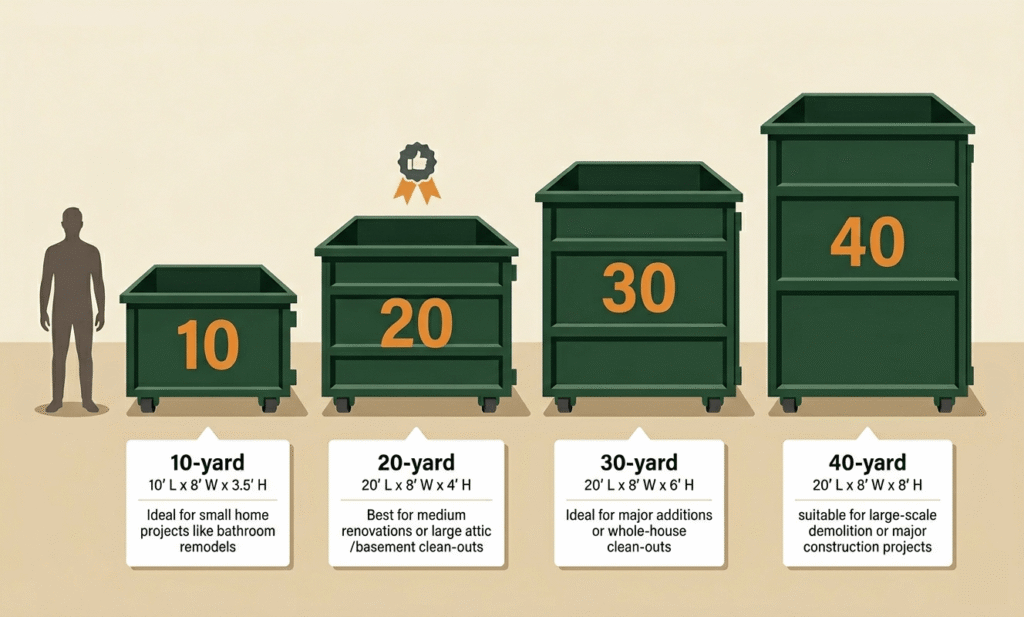
✓ Dimensions: Roughly 12 feet long, 8 feet wide, 3.5 feet tall
✓ Holds: About 3 pickup truck loads
✓ Best for: Small cleanouts (one room), minor landscaping, small bathroom remodels
✓ Weight limit: Typically 1–2 tons
✓ Dimensions: Roughly 22 feet long, 8 feet wide, 4.5 feet tall
✓ Holds: About 6 pickup truck loads
✓ Best for: Single-room renovations, estate cleanouts, medium decluttering projects, flooring removal
✓ Weight limit: Typically 2–3 tons
✓ Dimensions: Roughly 22 feet long, 8 feet wide, 6 feet tall
✓ Holds: About 9 pickup truck loads
✓ Best for: Multi-room renovations, large cleanouts, new construction debris, major decluttering projects
✓ Weight limit: Typically 3–5 tons
✓ Dimensions: Roughly 22 feet long, 8 feet wide, 8 feet tall
✓ Holds: About 12 pickup truck loads
✓ Best for: Major construction or demolition, commercial projects, whole-house cleanouts with heavy debris
✓ Weight limit: Typically 4–6 tons
Quick Size Comparison
| Size | Holds (Truck Loads) | Typical Weight Limit | Best For |
| 10-yard | ~3 | 1–2 tons | Small cleanouts, minor remodels |
| 20-yard | ~6 | 2–3 tons | Most residential projects |
| 30-yard | ~9 | 3–4 tons | Large renovations, big cleanouts |
| 40-yard | ~12 | 5–6 tons | Major construction, demolition |
A helpful rule of thumb: Five to six standard 33-gallon trash bags equal roughly one cubic yard. A standard pickup truck bed holds about two to three cubic yards. Use those benchmarks to estimate your volume.
When in doubt, go one size up. The price difference between sizes is usually $50 to $150. The cost of ordering a second dumpster because you ran out of room is much more.
How Much Does a Dumpster Rental Cost?
Pricing is the first thing most homeowners want to know. Fair enough. The national average for a dumpster rental falls around $650 to $700, but that number can range anywhere from roughly $250 to $1,500+ depending on several factors. Here’s what actually drives the price.
| Size | Average Cost Range |
| 10-yard | $250 – $450 |
| 20-yard | $350 – $600 |
| 30-yard | $450 – $750 |
| 40-yard | $550 – $900 |
These are national averages for a standard 7-day rental. Your actual cost will depend on where you live, what you’re throwing away, and which company you use.
What Affects the Price
Disposal fees vary significantly by region. A dumpster rental in a major metro area with high landfill costs will be more expensive than one in a rural area. The distance from the rental company’s yard to your property also factors in — longer hauls mean higher delivery costs.
Bigger containers cost more. But the price increase between sizes is usually modest compared to the jump in capacity. That’s why sizing up is almost always worth it.
Standard household junk and construction debris are the cheapest to dispose of. Heavy materials like concrete, brick, dirt, or roofing shingles often carry surcharges because they’re heavier per cubic yard and cost more at the landfill. Some companies offer dedicated “heavy debris” dumpsters with lower volume limits but higher weight allowances.
Most companies include 7 to 10 days in the base price. Need more time? Expect to pay $10 to $25 per extra day.
Every dumpster comes with a weight limit. Go over it, and you’ll pay $40 to $100 per additional ton. This is the most common surprise charge homeowners encounter.
Hidden Fees to Watch For
1. Overage fees for exceeding the weight limit
2. Extension fees for keeping the dumpster beyond the included rental period
3. Trip fees if the driver arrives and can’t access the delivery spot
4. Per-item fees for mattresses, appliances, or tires (where allowed)
5. Permit fees if the dumpster goes on a public street (this is paid to your city, not the rental company)
What’s Included in a Dumpster Rental
Most dumpster rentals are priced as a flat-rate package that bundles several things together:
Delivery of the container to your property
A set rental period (usually 7–10 days)
A weight allowance (typically measured in tons)
Pickup and hauling when you’re done
Disposal fees at the landfill or transfer station
That flat rate is your all-in price — as long as you stay within the weight limit and rental period. The simplicity is one of the biggest advantages of dumpster rental. You know what you’re paying before the container hits the ground.
Some companies also include same-day or next-day delivery, a swinging rear door for walk-in loading, and online account management for scheduling pickup when you’re ready.
How to Rent a Dumpster: Step by Step
01 Assess Your Project
Before you call anyone, get a rough sense of what you’re dealing with. Walk through the space. Look at the volume of debris. Think about the type of material — is it mostly lightweight household junk, or are you dealing with heavy construction materials like concrete and roofing shingles?
This step matters because it determines the size and type of dumpster you need. Overestimate slightly. It’s much cheaper to have extra room than to need a second container.
02 Choose the Right Size
Use the size guide above as a starting point. When you call the rental company, describe your project in detail — they do this every day and can usually recommend the right size based on a quick conversation.
Be honest about the scope. If you say “small bathroom remodel” but you’re actually gutting a full master bath plus the adjacent closet, you’ll end up undersized.
03 Get Quotes and Book
Call 2–3 companies. Ask for all-in pricing — delivery, rental period, weight allowance, pickup, and disposal. Compare quotes side by side. The lowest number isn’t always the best deal.
04 Check Permit Requirements
If the dumpster is going on your driveway or private property, you almost certainly don’t need a permit. If it has to go on a public street, sidewalk, or right-of-way, check with your city or municipality. More on this in the permits section.
05 Prepare the Delivery Spot
The truck that delivers your dumpster needs room to maneuver. Clear the area of vehicles, trash cans, basketball hoops, low-hanging branches — anything that could block access. The delivery truck typically needs about 60 feet of straight clearance and 23 to 25 feet of vertical clearance for overhead lines and branches.
If you’re placing the dumpster on your driveway, consider laying down plywood sheets to protect the surface from scratches and weight damage.
06 Receive the Dumpster
Most companies don’t require you to be home for delivery. The driver will place the container in the agreed-upon spot. If you have specific placement instructions — facing a certain direction, a particular spot on the driveway — communicate that clearly when you book.
07 Fill It Up
This is your part. Load the dumpster over the course of your project, following the loading tips and prohibited items guidelines in this guide. Stay within the fill line and weight limit.
08 Schedule Pickup
When you’re done — or when the rental period is ending — call to schedule pickup. Most companies can collect within one to two business days. The driver arrives, hooks the container, and hauls it to the disposal facility.
Where to Put a Dumpster and How to Prepare
Most homeowners put the dumpster in their driveway. It’s the most common and convenient placement — close to the house, on your own property, and easy for the truck to access.
Items That May Have Restrictions or Extra Fees
Permits: When You Need One and When You Don’t
Things to Know About Permits
Don’t skip the permit if you need one. The fine for an unpermitted dumpster on a public street is almost always more expensive than the permit itself.What You Can Put in a Dumpster
The good news: most of the stuff you’re trying to get rid of is fair game. Standard dumpster rentals accept a wide range of household and construction debris.Generally Accepted Items
Items That May Have Restrictions or Extra Fees
What You Can’t Put in a Dumpster
This is where most first-time renters get surprised. Dumpsters aren’t a free-for-all. Federal, state, and local regulations prohibit certain materials from going into a roll-off container.Permanently Prohibited Items
✓ Paints, stains, and lacquers (wet/liquid)
✓ Solvents, pesticides, and chemical cleaners
✓ Motor oil, transmission fluid, and automotive fluids
✓ Gasoline, kerosene, and other flammable liquids
✓ Asbestos-containing materials
✓ Medical waste and biohazardous materials
✓ Car batteries and lithium batteries
✓ Propane tanks (full or empty)
✓ Aerosol cans (unless completely empty)
✓ Fire extinguishers
✓ Compressed gas cylinders
✓ Refrigerators and freezers (unless Freon has been professionally removed)
✓ Air conditioning units
✓ Dehumidifiers
✓ TVs, monitors, and computer equipment
✓ These often fall under e-waste recycling laws
Why These Items Are Banned
It’s not arbitrary. Hazardous materials can leak, contaminate landfills, and create dangerous conditions for waste workers. Pressurized containers can explode inside compactor trucks. Refrigerants damage the ozone layer if released. Electronics contain heavy metals that leach into groundwater.What to Do With Prohibited Items
1. Paints and chemicals: Local household hazardous waste (HHW) collection events or drop-off sites2. Batteries: Retailers like AutoZone, Home Depot, or dedicated recycling centers
3. Propane tanks: Many propane dealers accept empty tanks for recycling
4. Electronics: E-waste recycling programs, often run by your city or county
5. Refrigerant appliances: Hire a certified technician to remove Freon first, then the appliance may be accepted
How to Load a Dumpster the Right Way
There’s a right way and a wrong way to fill a dumpster. Do it well, and you’ll maximize your space and avoid extra charges. Do it poorly, and you’ll either waste capacity or end up with an overweight container.✓ Don’t put all the heavy stuff on one side. Uneven weight distribution makes the container dangerous to lift and transport.
✓ Don’t set items beside the dumpster thinking the crew will load them. They won’t. Anything outside the container stays behind.
✓ Don’t pack prohibited items under other debris hoping no one will notice. Drivers check. Disposal facilities check. You’ll get charged extra or have your pickup refused.
Common Dumpster Rental Mistakes
Most of these are avoidable. Here’s what trips up first-time renters.
01 Renting the Wrong Size
The single most common mistake. Going too small means needing a second delivery — which can double your cost. Going too big means paying for space you don’t use, though the price difference between sizes is usually small enough that oversizing is the smarter gamble.
02 Ignoring the Weight Limit
Volume is what you see. Weight is what you pay for if you go over. A 20-yard dumpster full of old furniture and household junk might weigh 2 tons. That same dumpster half-full of concrete could weigh 4 tons. Know your weight limit. Ask the rental company what’s realistic for your type of debris.
03 Not Asking About All Fees Upfront
The base quote isn’t always the final bill. Extension fees, overage charges, per-item surcharges, trip fees for failed deliveries, permit costs — these add up. Get a complete breakdown before you commit.
04 Blocking the Dumpster
Your rental is useless if you can’t reach it. Don’t park cars next to it. Don’t stack items around it. Keep the loading area clear for the entire rental period. And keep the approach clear for the pickup truck when it’s time.
05 Waiting Too Long to Book
Spring and summer are peak seasons for dumpster rentals. Demand surges during nice weather when everyone decides to renovate, clean out, and do yard work. Book at least a week ahead during busy months. During off-season, a few days’ notice usually works.
06 Putting Prohibited Items in the Dumpster
This one can be expensive. If the disposal facility finds banned materials, the rental company gets fined — and passes that fine along to you. In some cases, the entire load gets rejected and you’re responsible for the re-sorting cost. Just follow the prohibited items list.
Dumpster Rental vs. Junk Removal: Which One Do You Actually Need?
This is the comparison most homeowners don’t think to make — but should. Dumpster rental and junk removal are two different services that solve related problems. Choosing the wrong one can cost you more money, more time, or more physical effort than necessary.
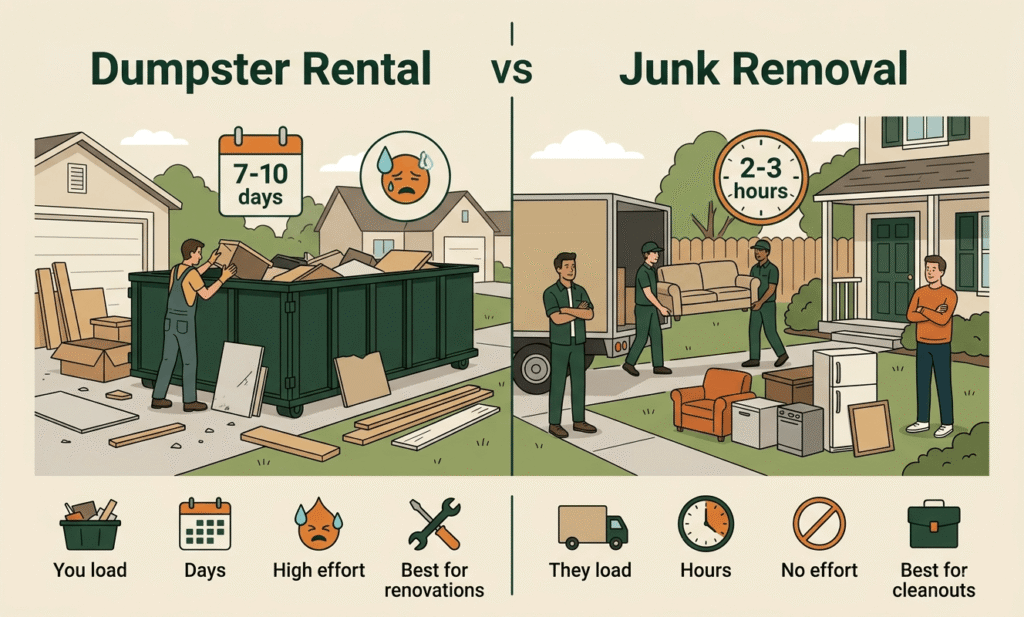
Dumpster Rental: You Do the Work
✓ Projects generating debris over multiple days
✓ Situations where you want to work at your own pace
✓ Construction or demolition waste
✓ Homeowners who are physically able to handle the loading
✓ Projects with predictable, high-volume waste
✓ With a junk removal service, a crew shows up with a truck. They do all the loading.
Junk Removal: They Do the Work
✓ Cleanouts where you need it done quickly (same day or next day)
✓ Bulky, heavy items like furniture, appliances, and mattresses
✓ Situations where you physically can’t do the lifting (age, injury, disability)
✓ Estate cleanouts where sorting and sensitivity matter
✓ Hoarding cleanups that require care, judgment, and sometimes specialized handling
✓ Mixed loads that include items needing different disposal methods
✓ Properties where a dumpster can’t be placed (narrow driveways, no street access)
| Factor | Average Cost Range | Junk Removal |
| Who loads? | You | The crew |
| Timeline | 7–10 days | A few hours |
| Average cost | $300–$700 | $200–$800+ |
| Physical effort | High | None |
| Best for | Renovation debris, extended projects | Quick cleanouts, heavy/bulky items |
| Scheduling | Flexible fill time | Set appointment |
| Sorting/donating | Your responsibility | Many companies handle it |
| Prohibited items | Your problem | Company often handles proper disposal |
Choose a dumpster
when your project will generate waste over several days, the debris is mostly construction materials, and you’re comfortable doing the physical work.
Choose junk removal
when you want the job done fast, the items are heavy or awkward, you can’t or don’t want to do the lifting yourself, or the situation involves emotional or logistical complexity — like an estate cleanout or a hoarding cleanup.
Consider both
for large renovation projects: a dumpster for the ongoing construction debris and a junk removal crew for the old furniture, appliances, and bulky items that are too heavy or awkward to handle alone.
How to Choose a Dumpster Rental Company
Not all dumpster rental companies operate the same way. Here’s what to look for and what to watch out for.
01 Transparent, all-in pricing
They give you one number that covers delivery, rental period, weight allowance, pickup, and disposal. No surprises.
02 Clear weight limits and overage policies
They tell you exactly what happens if you exceed the limit and how much it costs per ton.
03 Honest size recommendations
They ask about your project and suggest the right size — even if it’s a smaller, cheaper option.
04 Flexible scheduling
They accommodate your timeline and don’t charge excessive fees for minor date changes.
05 Responsive communication
They pick up the phone. They return calls. They confirm delivery windows.
Red Flags
Questions to Ask Before Booking
1. What’s the all-in price including delivery, pickup, and disposal?
2. What’s the weight limit? What do I pay per ton if I go over?
How many days does the rental include? What’s the daily extension fee?
3. Are there extra charges for specific items (mattresses, appliances, tires)?
4. Do you handle the permit if I need one?
5. What’s your delivery window? Can I specify a time?
6. What happens if I need the dumpster picked up early?
Frequently Asked Questions About Dumpster Hauling
How far in advance should I book a dumpster rental?
During peak season (spring and summer), book at least a week ahead. During fall and winter, two to three days is usually enough. For specific dates — like the start of a contractor’s project — book as early as possible to lock in availability.
Do I need to be home when the dumpster is delivered?
Usually not. Most companies will place the dumpster at the agreed-upon location whether you’re home or not. Just make sure the area is clear and accessible before the delivery window. If you have specific placement instructions, communicate them clearly when you book.
Can I extend my rental period?
Yes. Most companies offer daily extensions for $10 to $25 per day. Call before your rental period expires to avoid unexpected charges. Some companies charge automatically for extra days; others require you to request an extension.
What happens if I go over the weight limit?
You’ll be charged an overage fee — typically $40 to $100 per additional ton. The disposal facility weighs the container when the truck arrives, and the rental company passes any overages on to you. If you’re disposing of heavy materials (concrete, dirt, roofing), ask the rental company to help you estimate the weight beforehand.
Can I put a dumpster on the street?
In most cities, yes — but you’ll need a permit from your local municipality. Permit costs range from $25 to $150, and processing times vary. Some rental companies will handle the permit application for you.
How much weight can a dumpster hold?
It depends on the size. A 10-yard dumpster typically has a 1- to 2-ton weight limit. A 20-yard allows 2 to 3 tons. A 30-yard allows 3 to 5 tons. And a 40-yard allows 4 to 6 tons. Heavy debris dumpsters may have lower volume limits but higher weight allowances.
Is a dumpster rental cheaper than junk removal?
It depends on the project. For large volumes of lightweight debris — like a renovation generating drywall, lumber, and old carpet — a dumpster is usually cheaper. For smaller jobs with heavy or bulky items, junk removal can be more cost-effective because you’re paying for labor and hauling, not container space you might not fill. The real question isn’t which is cheaper — it’s which is the right tool for the job. See the full comparison above.
What if it rains while the dumpster is in my driveway?
Rain generally isn’t a problem for most debris types. Construction waste, furniture, and household junk can get wet without issue. However, water adds weight — and weight costs money if you’re near your limit. If you’re concerned, you can cover the dumpster with a tarp during heavy rain, though most homeowners don’t bother.
Can I move the dumpster after it’s been placed?
No. Once a roll-off dumpster is placed, it stays where it is until pickup. These containers are extremely heavy even when empty — often 3,000 to 5,000 pounds — and require a specialized truck to move. If placement matters to you, be precise about location when you book.
Will a dumpster damage my driveway?
It’s possible. Roll-off dumpsters are heavy, and the wheels and frame can scratch or crack concrete and asphalt — especially in hot weather when surfaces soften. Placing plywood sheets under the container’s contact points is the simplest way to protect your driveway. Many experienced renters do this as standard practice.
Compare junk removal companies near you
Get a real quote from local haulers in these cities.
- Junk removal in Houston
- Junk removal in Sacramento
- Junk removal in Long Beach
- Junk removal in Chicago
- Junk removal in Phoenix
- Junk removal in Glendale
- Junk removal in Santa Clarita
- Junk removal in San Bernardino
- Junk removal in Berkeley
- Junk removal in Austin
- Junk removal in Anaheim
- Junk removal in Fremont
- Junk removal in Oceanside
- Junk removal in Chula Vista
- Junk removal in Fresno
- Junk removal in Stockton
- Junk removal in New York
- Junk removal in Indianapolis
- Junk removal in Dallas
- Junk removal in Tucson
- Junk removal in Santa Rosa
- Junk removal in Bakersfield
- Junk removal in Raleigh
- Junk removal in Oxnard
Not sure how big your load is? Check it with the cubic yard visualizer.