
How to Get Rid of a Mattress: 6 Options, Costs and Rules
By Jim Stogiannos · August 6, 2026
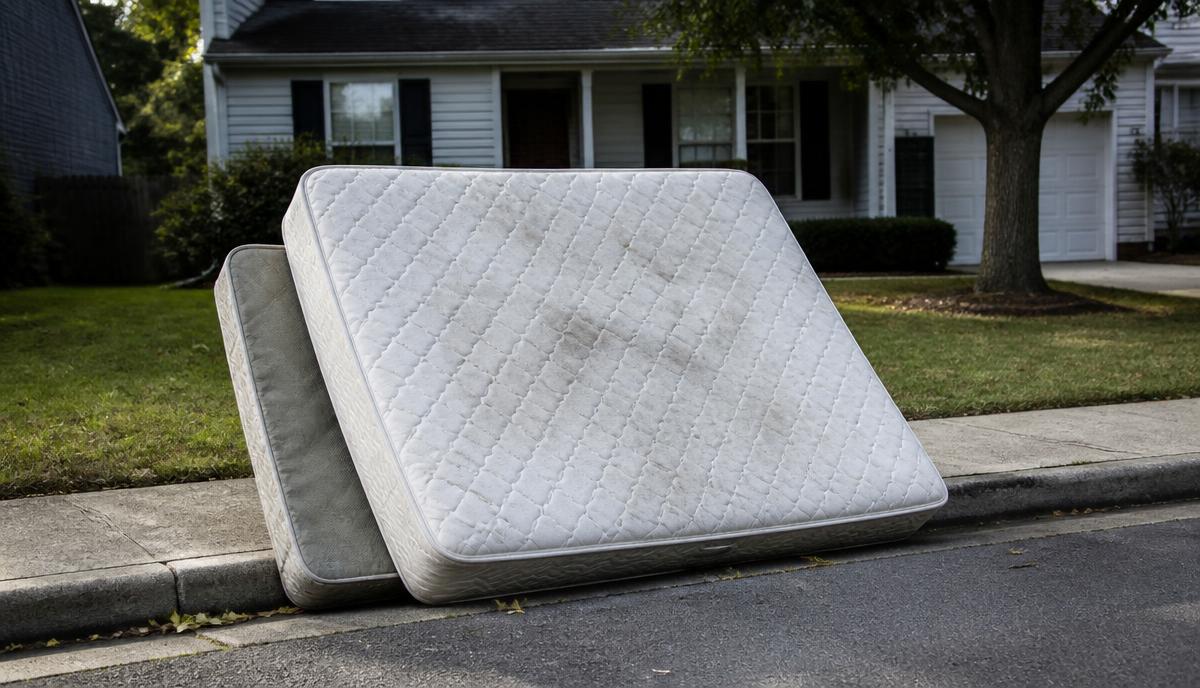
You have five real ways to get rid of a mattress: a state recycling program, retailer haul-away when a new one is delivered, your city’s bulk trash pickup, donation, or a junk removal company. Which one fits depends on where you live, how fast you need it gone, and whether you can move a 60–100 lb mattress yourself.
Mattresses are one of the hardest household items to throw away. They do not fit in a trash can, most landfills charge a special fee for them, and a growing number of states ban them from curbside garbage entirely. Here is what actually works, what each option costs, and how long it takes.
Your options at a glance
| Option | Typical cost | How fast | What it requires |
|---|---|---|---|
| State recycling program drop-off | Free (already paid via recycling fee) | Same day | You live in CA, CT, RI or OR and can transport it |
| Retailer haul-away with new mattress | $0–$100 | On delivery day | You are buying a replacement; usually 1-for-1 |
| Municipal bulk pickup | Free to $50 | Days to several weeks | Scheduling, and often bagging or a tag |
| Donation or resale | Free | 1–2 weeks | Clean, no stains, no bed bugs, no sagging |
| Junk removal company | $75–$175 for one mattress | Often same or next day | Nothing – they carry it out |
| Transfer station / landfill yourself | $20–$60 dump fee | Same day | A truck or van, plus help lifting |
If you need it gone this week and you cannot lift it out of the bedroom, hiring a hauler is the only option that reliably works. Everything else trades money for time or effort.
1. Check for a state mattress recycling program first
Four states run a statewide mattress recycling program funded by a small fee you already paid when you bought the mattress: California, Connecticut, Rhode Island and Oregon. It is operated by the nonprofit Mattress Recycling Council under the Bye Bye Mattress program, which lists free drop-off locations and participating collection events by ZIP code.
Two things to know:
- Drop-off is free at participating sites, usually with a limit on how many units per visit. You still have to get the mattress there.
- Some cities in those states also offer free curbside collection through the same program. Check the site before you pay anyone.
Outside those four states, mattress recycling still exists but is patchy – some municipal transfer stations, some private recyclers, and some haulers who separate materials. Roughly 75% of a mattress by weight is recyclable: the steel springs go to scrap, the foam becomes carpet padding, the wood frame becomes mulch or biomass, and the cotton and fiber are reused. That is why recycling is worth two minutes of searching before you send it to a landfill.
2. Have the retailer haul it away when the new one arrives
This is the easiest option if you are replacing the mattress anyway. Most large mattress and furniture retailers, and most online brands that use white-glove delivery, will remove your old mattress on the delivery visit for $0–$100.
The catches are consistent across retailers:
- It is almost always one-for-one – they take away the item they are replacing, not a spare from the garage.
- It must usually be arranged when you order, not mentioned at the door. Delivery crews often cannot add it on the spot.
- Many retailers refuse soiled, wet, infested or badly damaged mattresses for driver safety reasons.
- Basic threshold delivery (curbside drop-off) usually does not include haul-away at all.
Ask specifically: “Does this include removal of my old mattress and box spring?” The box spring is the piece people forget, and it is often a separate charge.
3. Use your city’s bulk trash pickup
Most US cities run some form of large-item or bulk collection, either on a fixed schedule for your street or by appointment. It is the cheapest option that does not require a truck – often free, sometimes $20–$50 per item or per pickup.
Rules vary enormously by city, so check your sanitation department’s page rather than assuming. The requirements you are most likely to hit:
- Encasing the mattress in a plastic bag or mattress disposal bag. Many cities now require this to control bed bug spread, and crews will leave an unbagged mattress at the curb. Bags cost about $10–$20 at a hardware store.
- A sticker, tag, or scheduled appointment before it goes out. Putting it out unscheduled can earn you an illegal dumping citation.
- An item limit per pickup – a mattress and box spring may count as two items.
- A narrow window for putting it out, often the evening before collection only.
The real downside is timing. In many cities the next bulk collection date is two to six weeks out, and appointment slots fill up. If the mattress cannot sit in a garage or spare room until then, this option does not solve your problem.
4. Donation: honest expectations
Most people assume a thrift store will take a used mattress. Usually it will not. Health regulations in many states restrict reselling used bedding, and even where it is legal, most Goodwill and Salvation Army locations decline mattresses because of liability and bed bug risk. Habitat for Humanity ReStore policies vary by store – some accept them, most do not.
Who does sometimes accept a mattress in genuinely good condition:
- Homeless shelters, transitional housing programs and family shelters – call first, and expect them to inspect it.
- Furniture banks that serve families leaving shelters or resettling refugees.
- Some animal shelters take mattresses and foam for bedding material, even ones too worn to sleep on.
- Local marketplace listings at $0 – a clean mattress often finds a taker who collects it, which turns a $100 expense into a free pickup.
A mattress is not donatable if it has stains, rips, a visible sag, a smell, or any history of bed bugs. Offering one that does wastes a nonprofit’s time and will simply be refused at the door.
5. Hire a junk removal company
This is what most people end up doing when the mattress is upstairs, the city pickup is a month away, and no one is buying a new one. A crew arrives, carries it out of the bedroom, and takes it to a recycler or transfer station.
| Job | Typical price |
|---|---|
| Single mattress, curbside or ground floor | $75–$150 |
| Mattress and box spring together | $100–$200 |
| Mattress set from an upper floor or with a long carry | $125–$225 |
| Mattress added to a larger cleanout load | $25–$60 extra |
| Bed bug–infested mattress (sealed handling) | $150–$300 |
Two ways to pay less: schedule it alongside other junk you already need gone, and be flexible on the date so you can go on a route the hauler is already running. Minimum-charge trips are the most expensive way to buy junk removal. For the full picture on pricing, see our guide to what junk removal costs in 2026, or estimate your load with the cost calculator.
Before you book, ask whether the price includes the disposal fee, whether they recycle mattresses or landfill them, and whether they are insured for damage to walls and stair railings on the way out.
What not to do
Leaving a mattress at the curb without a scheduled pickup, in an alley, next to a dumpster, or beside a donation bin is illegal dumping in essentially every US city. Fines commonly start around $250 and run into the thousands for repeat offenses, and cities increasingly identify the source from delivery records or camera footage. An abandoned mattress also absorbs rain, becomes a rodent and mosquito habitat within days, and costs the city far more to remove than the pickup fee you avoided.
Also skip these:
- Do not put a mattress in a rented dumpster without asking. Many dumpster companies exclude mattresses or charge a per-unit surcharge, and you will find out on the invoice.
- Do not burn it. Foam and fire retardants release toxic smoke, and it is illegal nearly everywhere.
- Do not move a bed bug mattress through the house unwrapped. Seal it in plastic in the room it is in, then carry it out.
Can you take it apart yourself?
Yes, and it is a legitimate option if your transfer station charges by volume or refuses whole mattresses. With a utility knife, pliers and bolt cutters you can strip the cover, pull the foam and fiber, and separate the spring unit and wood frame in about an hour. The steel goes to a scrap yard, sometimes for a few dollars. The foam and fabric still need a bin.
Be realistic: it is dusty, awkward work, coil ends are sharp, and a memory foam mattress has almost nothing worth separating. If you are hauling it yourself anyway and it fits in your vehicle, cutting it up rarely pays for itself. It only matters when a facility will not accept it intact. If you are trying to figure out whether it will fit in your truck at all, our cubic yard visualizer gives you a sense of the space a mattress set takes.
Find a hauler who will take it near you
Most of the mattresses we see moved are moved by local independent haulers – they are cheaper than national chains on single-item jobs and more likely to run it to a recycler. Browse companies in your city and ask two or three for a price on a single mattress:
- Search junk removal companies by city or ZIP
- Oakland, CA · Plano, TX · Fort Lauderdale, FL · Tucson, AZ · Indianapolis, IN · Alexandria, VA
When you call, say “one queen mattress and box spring, second floor, need it this week” and ask for an all-in price. That one sentence gets you an accurate quote faster than anything else. It also helps to know what junk removal companies can and cannot take if you are adding other items to the trip.
Frequently asked questions
Will they take the box spring too?
Yes, but count it as a second item. Retailers usually charge separately for it, city bulk pickup often counts it against your item limit, and haulers typically add $25–$60. Say “mattress and box spring” up front so the quote is right.
Does the mattress need to be wrapped in plastic?
For city curbside pickup, very often yes – many sanitation departments require a sealed mattress bag to limit bed bug spread and will skip an unbagged mattress. For junk removal and drop-off, it is usually optional but appreciated. Bags run about $10–$20.
Can I put a mattress in a dumpster?
Only if your rental agreement allows it. Many dumpster companies prohibit mattresses outright or charge a per-mattress surcharge because landfills bill them separately. Ask before it goes in, not after.
What do I do with a mattress that has bed bugs?
Seal it in plastic before it leaves the room, label it, and tell whoever collects it. Do not donate it, do not resell it, and do not leave it at a curb unwrapped. Some cities require a sealed bag by ordinance for this exact reason, and haulers usually charge more for the extra handling.
How do I get rid of a Sleep Number, air bed, or adjustable base?
Break it into parts. The air chambers and foam go out as bulk waste, the pump and remote are e-waste at most household hazardous waste or electronics drop-offs, and an adjustable base is scrap metal with a motor. A hauler will take the whole assembly, but expect adjustable-base pricing closer to a full mattress set than a single item.
Is mattress disposal free anywhere?
Yes – drop-off is free at participating sites in California, Connecticut, Rhode Island and Oregon through the statewide recycling program, and many cities include one or two bulk items per year at no cost. Free means free of extra charge; you still handle transport or wait for the scheduled pickup.
How much does it cost to get rid of one mattress?
Between $0 and about $175 for most people. Free if a state program, a retailer promotion, or an included city bulk pickup covers it; $20–$60 if you drive it to a transfer station yourself; $75–$175 if a junk removal crew carries it out for you.