
How to Price a Junk Removal Job: Volume, Weight, and the Dump-Fee Math
By Jim Stogiannos · August 9, 2026
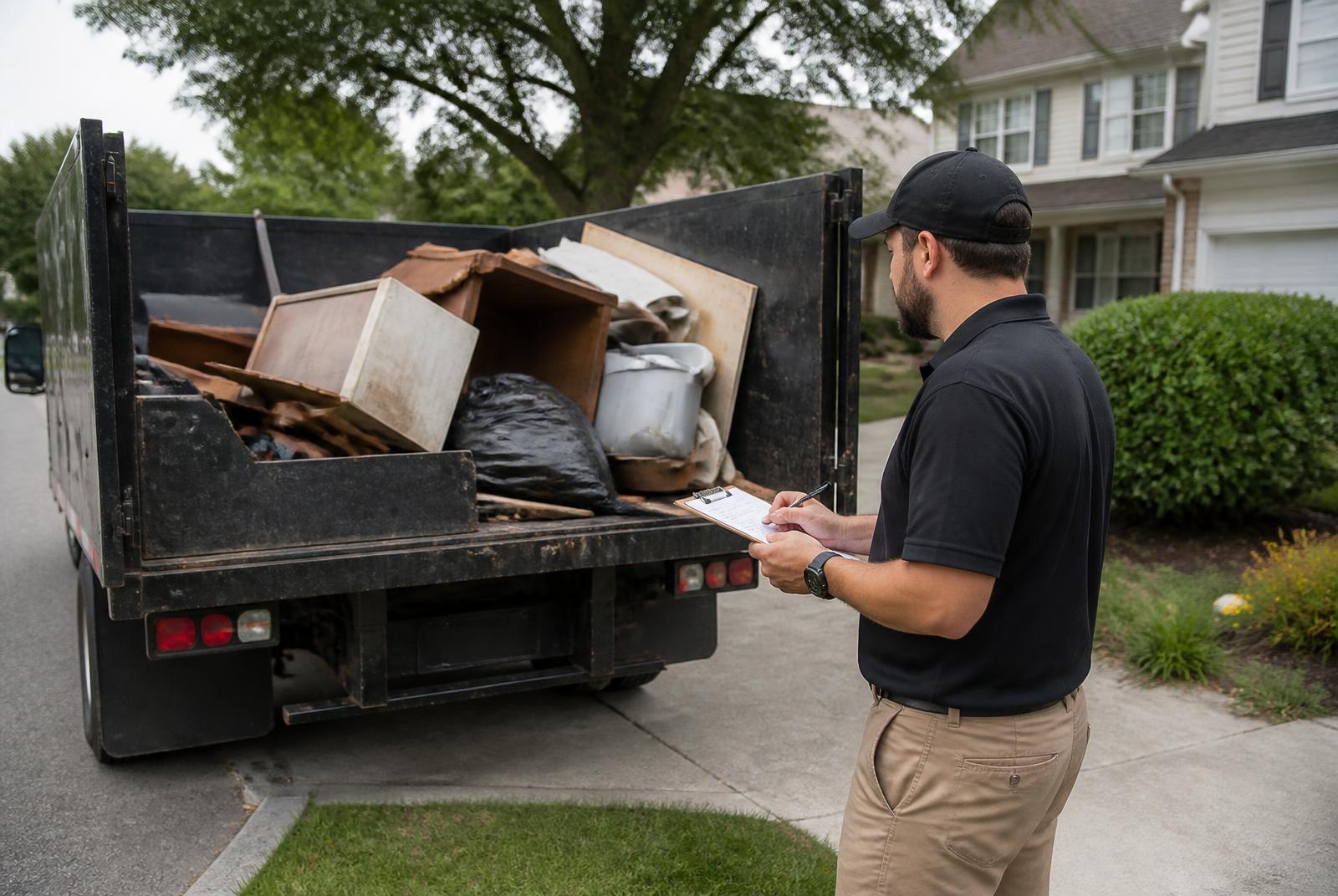
Price by volume, check every quote against weight, and never quote a number that does not cover your disposal cost plus roughly three times your labor cost for the visit. That is the whole discipline. Most operators who struggle are not underpricing on purpose – they are quoting from a gut feel that ignores tonnage and drive time.
This is the pricing framework used by profitable independent haulers: how the three pricing models actually behave, how to build your own rate card from your real costs, when to quote sight-unseen, and the jobs that quietly lose money.
The three pricing models
| Model | How it works | Best for | Where it hurts you |
|---|---|---|---|
| Volume (by truck fraction) | You charge by the share of the truck bed the load fills – 1/8, 1/4, 1/2, 3/4, full | Almost all residential work | Dense loads: dirt, tile, shingles, concrete fill a small space and max out your weight limit |
| Weight (by ton) | You charge a base fee plus a per-ton rate, tied to your scale ticket | Construction debris, roofing, remodel cleanouts | Light bulky loads: a garage of foam and cardboard weighs nothing and pays nothing |
| Hourly / labor | Crew rate per hour plus disposal at cost or with markup | Hoarding cleanouts, sorting jobs, multi-day estate work | Customers hate open-ended pricing, and you get punished for being fast |
Use volume as your default because it is what customers understand and what the national brands trained the market to expect. Keep weight pricing in your back pocket for heavy material and hourly for jobs where the work is sorting rather than hauling.
Build your rate card from your real numbers
Before you can price a job you need four numbers from your own business. Pull them from last month, not from a competitor website.
- Loaded labor cost per hour. Wages plus payroll taxes, workers comp and any benefits, for every person on the truck. If you pay $20/hr, your true cost is closer to $26–$30/hr.
- Truck cost per hour. Payment or depreciation, insurance, fuel, maintenance and tires, divided by the hours you actually run per month. Most single-truck operations land somewhere around $15–$30/hr.
- Disposal cost per load. Your average scale ticket for a full truck, plus per-item surcharges at your facility (mattresses, tires, appliances with refrigerant, electronics).
- Average job cycle time. Drive to the job, load, drive to the transfer station, wait in line, dump, and get back in service. The dump trip is the part rookies forget, and it is often 45–90 minutes on its own.
Then price so every job clears this floor:
Minimum price = disposal cost for that load + (labor cost + truck cost) x full cycle hours x 3
The 3x on labor is not greed. It is what covers your overhead – phone answering, advertising, software, licensing, insurance, admin time, unbilled drive time – and leaves an actual profit. Charge 1.5x and you are buying yourself a job with no margin for a broken transmission.
Worked example: a half-truck garage cleanout
| Two-person crew, loaded labor | $28/hr x 2 = $56/hr |
| Truck cost | $22/hr |
| Full cycle time (drive, load, dump, return) | 2.5 hours |
| Labor + truck for the job | $78 x 2.5 = $195 |
| Disposal (about 1.1 tons at $65/ton, plus one mattress fee) | $96 |
| Cost floor | $291 |
| Target price at 3x labor and truck | $195 x 3 + $96 = $681 |
| Realistic market price for a half truck | $300–$400 |
Read that gap carefully, because it is the single most useful thing on this page. If a half-truck job in your market sells for $350 and your cost floor is $291, the job is not profitable – the problem is your cycle time, your crew size, or your dump cost, not the customer. Profitable operators fix it by tightening routing, running a two-stop trip before dumping, negotiating disposal rates, or repositioning toward jobs where volume pays better per hour. Compare your own numbers against the consumer-facing ranges in our junk removal cost guide, since that is roughly what your customers expect to pay.
Set a real minimum
Every load has fixed cost: you drove there, you drove to the dump, you paid the gate fee. That means a single-item pickup and a 1/8 load cost nearly the same to serve. Your minimum should cover the trip, typically $80–$150 depending on your market and drive distance. Publish it. Operators without a stated minimum spend their week driving 40 minutes for a $45 mattress.
When to quote sight-unseen – and when not to
Quote over the phone when all three are true: the customer can describe the items clearly, there is no stairs or long carry, and nothing is dense or hazardous. Ask for photos and quote a range whenever the job involves a basement or second floor, a narrow alley or gated backyard, construction debris, appliances with refrigerant, or the words “my mother passed away” or “we just need it all gone.”
Four questions that prevent almost every bad quote:
- What are the largest three items, and roughly how many boxes or bags?
- Which floor is it on, and how far is the walk to where we can park?
- Is there any paint, oil, chemicals, tires, propane or a fridge in there?
- Is it all going, or are you still deciding on some of it?
That last question catches the job that becomes a two-hour sorting session for a one-hour price.
The jobs that quietly lose money
| Job type | Why it bleeds | How to price it |
|---|---|---|
| Dirt, concrete, tile, shingles | Fills 1/4 of the bed, hits your legal weight limit | Quote by the ton, not by volume, and cap the load |
| Single mattress across town | 90 minutes of cycle time for a low ticket | Enforce your minimum or batch it with a nearby route stop |
| Third-floor walkup | Carry time triples labor per cubic yard | Add a stairs or long-carry surcharge, stated up front |
| Hoarding and estate cleanouts | Sorting time is invisible in a volume quote | Hourly crew rate plus disposal at cost |
| “Just take a look and tell me” add-ons | Scope creeps after the price is set | Write the item list on the ticket and re-quote additions on site |
Raise the price without losing the job
Most customers are not shopping purely on price – they are shopping on certainty. Quote the number confidently, say exactly what is included (labor, hauling, sweep-up, disposal fees, taxes), and name the one thing that would change it. A quote that reads “$385 all in, including dump fees, unless there is paint or tires in the pile” wins against a vaguer $340.
Two more levers that beat discounting: charge for same-day service, and price the second item cheaply so the average ticket rises. It costs you almost nothing to add a chair to a half-load, and it makes your quote feel generous.
Get more shots on goal
Pricing discipline only pays if enough people are calling. If your phone is quiet, being listed where homeowners are already searching for a hauler is the cheapest fix – add your junk removal business to the directory and start taking quote requests from your service area.
Frequently asked questions
Should I put prices on my website?
Publish your minimum and a range by load size, not exact figures for every scenario. Ranges pre-qualify callers and filter out the $40 shoppers, while still leaving room to price the job you actually see.
How do I compete with the national franchises on price?
Usually you do not need to. Independents win on responsiveness, same-day availability and talking to the owner. Match their structure so the comparison is easy, then beat them on the parts that cost you nothing: answering the phone, arriving in the window, and quoting all-in.
What margin should a junk removal job make?
Aim for gross margin of 60–70 percent after disposal and direct labor on a typical residential load, which is what leaves 10–20 percent net after overhead once you are running a truck full time. If a job type consistently comes in under that, it is a pricing problem, not a bad month.
Do I charge for estimates?
No for photos and phone quotes. For a large on-site walkthrough, book it as a scheduled estimate and be clear it is free but time-limited – free unlimited estimates on big commercial jobs is how you lose a day a week.
How do I handle a customer who adds items after I quote?
Re-quote on the spot, before it goes on the truck. Say the price for the added items, get a yes, and note it on the ticket. Silently absorbing add-ons is the most common way a profitable job turns into a break-even one.