
Junk Removal SEO in 2026: What Actually Changed on Google, and What Still Brings Calls
By Jim Stogiannos · October 9, 2026
If you run a junk removal company and you’ve been checking your rankings lately, you may have noticed something that doesn’t add up. You’re still on page one. You might still be in the map pack. But the phone isn’t ringing the way it did eighteen months ago.
That does not necessarily mean your site or its search work failed. The page you’re ranking on changed shape underneath you.
Here’s what actually happened, with the numbers, and what it means for a company running one to five trucks.
1. Most searches no longer send anyone to a website
This is the big one, and it isn’t a theory.
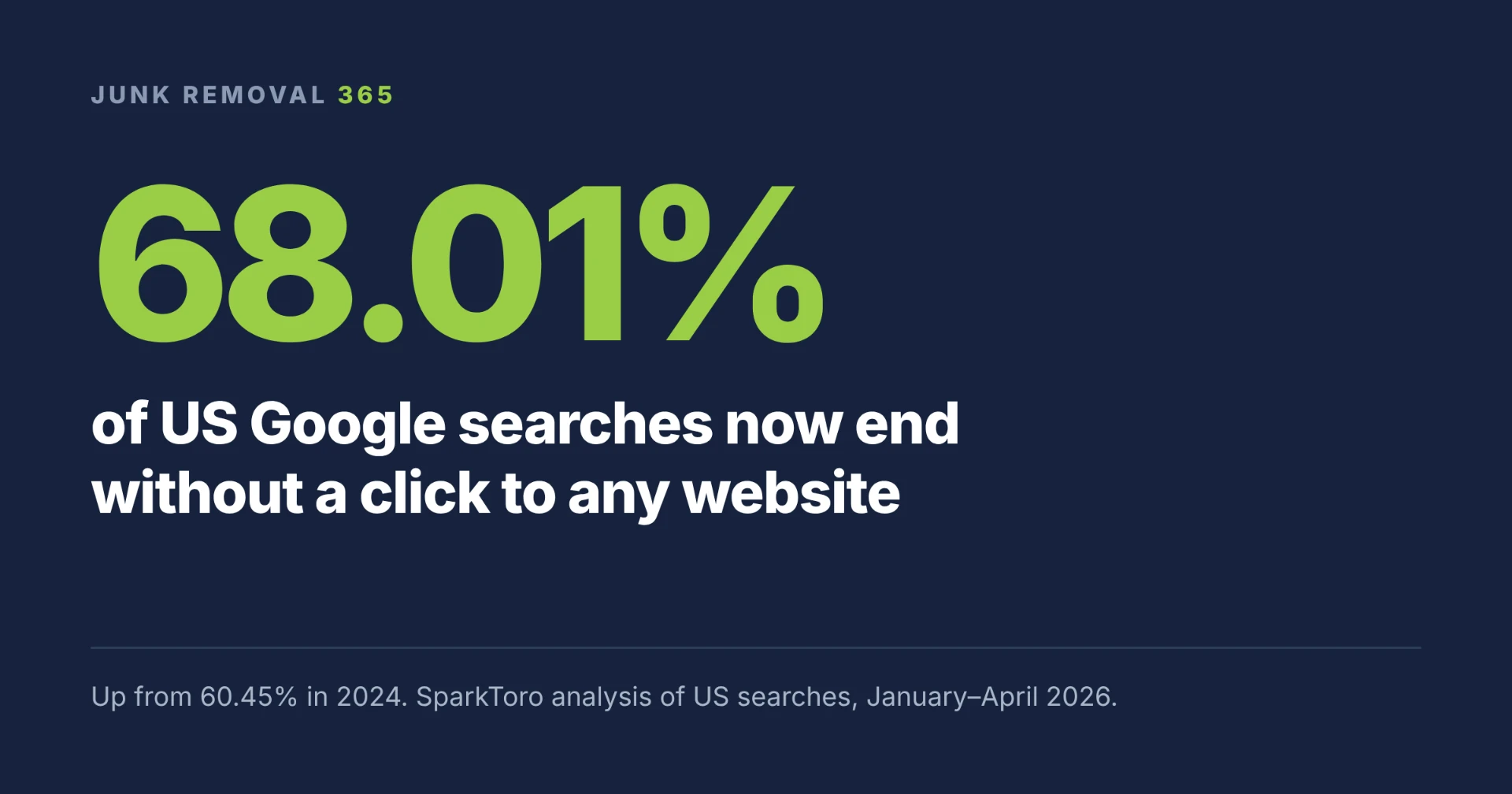
SparkToro analysed US Google searches from January to April 2026 using Similarweb’s desktop and mobile web panels. 68.01% of searches ended without a single click to any website — up from 60.45% in 2024. Over those two years, the share of searches that produced at least one click fell by 9.51 percentage points, a 22.9% decline.
Read that again, because it’s the whole story in one line: roughly two out of three searches now end on Google. The searcher got what they needed and never left.
That number excludes the Google mobile app, so it does not represent every Google search.
What this means for you is uncomfortable but simple. Ranking is no longer the same thing as traffic. You can climb the rankings and lose calls at the same time, because the number of people leaving the results page at all keeps shrinking.
2. AI Overviews take the click before you get it
AI Overviews — the AI-written summary that sits above the results — now appear on more than 20% of Google searches. When one appears, click-through rates to the listed results drop by nearly 60%.
That hits informational searches hardest. “How much does it cost to remove a hot tub,” “what can junk removal companies take,” “how do I get rid of a mattress” — those are exactly the questions that used to bring a homeowner to your site, where they’d read something useful and then call you. Now a lot of them get answered in the box at the top.
There’s a second product behind it. Google’s AI Mode accounted for only 0.34% of searches in the January–April SparkToro window, so it was still a small share then. But Google said at I/O 2026 that AI Mode had passed one billion monthly users and that query volume had more than doubled each quarter since launch. That trajectory is the part worth watching.
3. The local pack is getting smaller — and the call button is disappearing
This is the change that matters most to a local service business, and it’s had far less attention than AI Overviews.
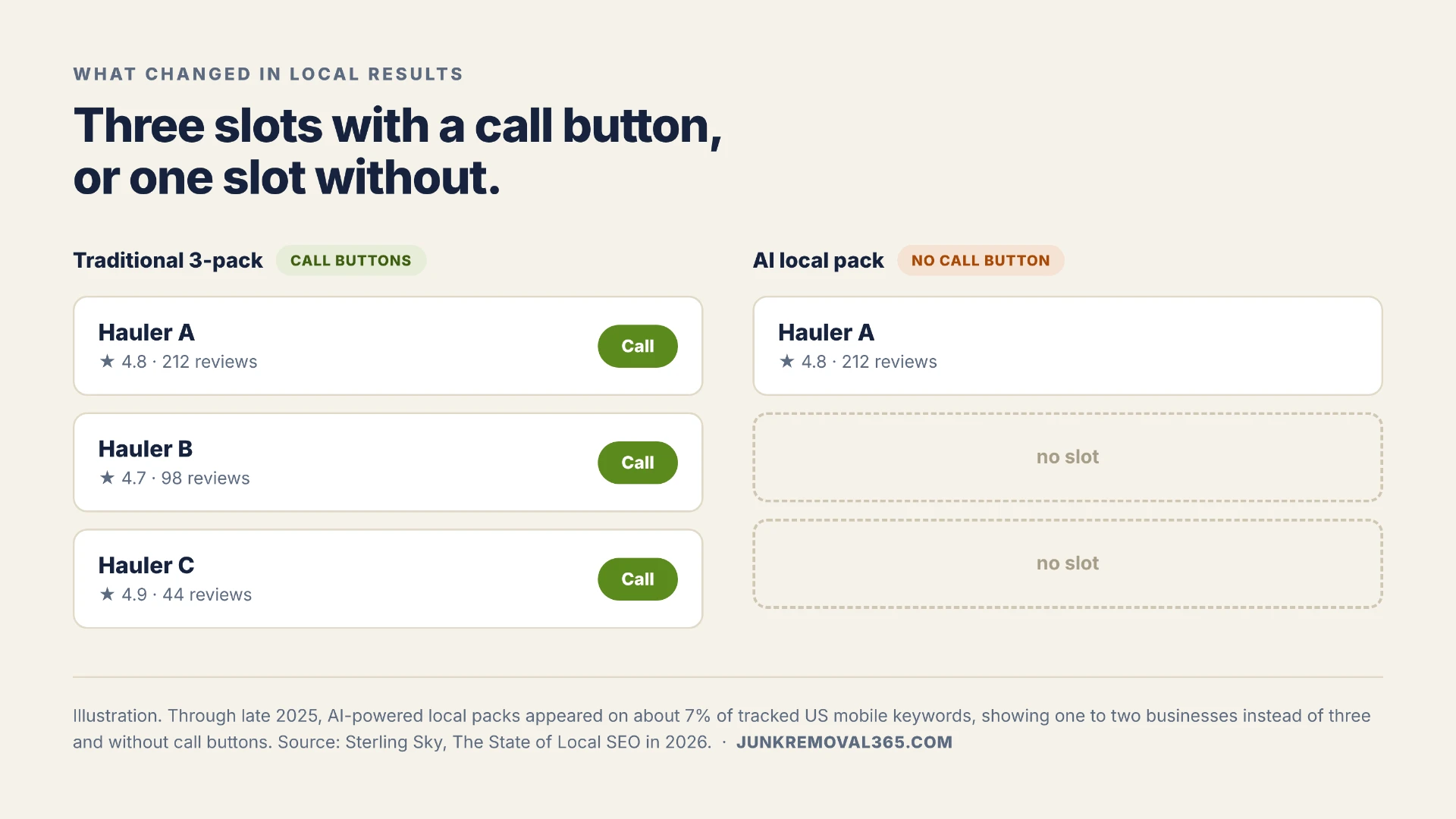
Sterling Sky tracked the rollout of newer AI-powered local packs on mobile in the US. Through late 2025 they appeared on about 7% of tracked keywords. Where these AI packs show up:
- They display one or two businesses instead of three.
- They frequently show different businesses than the traditional three-pack.
- They don’t have call buttons.
And the squeeze is real. Across their data, AI local packs surfaced 5,943 unique businesses compared with 18,330 in traditional three-packs — about a third as many. In 88% of the 322 markets they studied, the AI pack showed fewer unique businesses than the normal one.
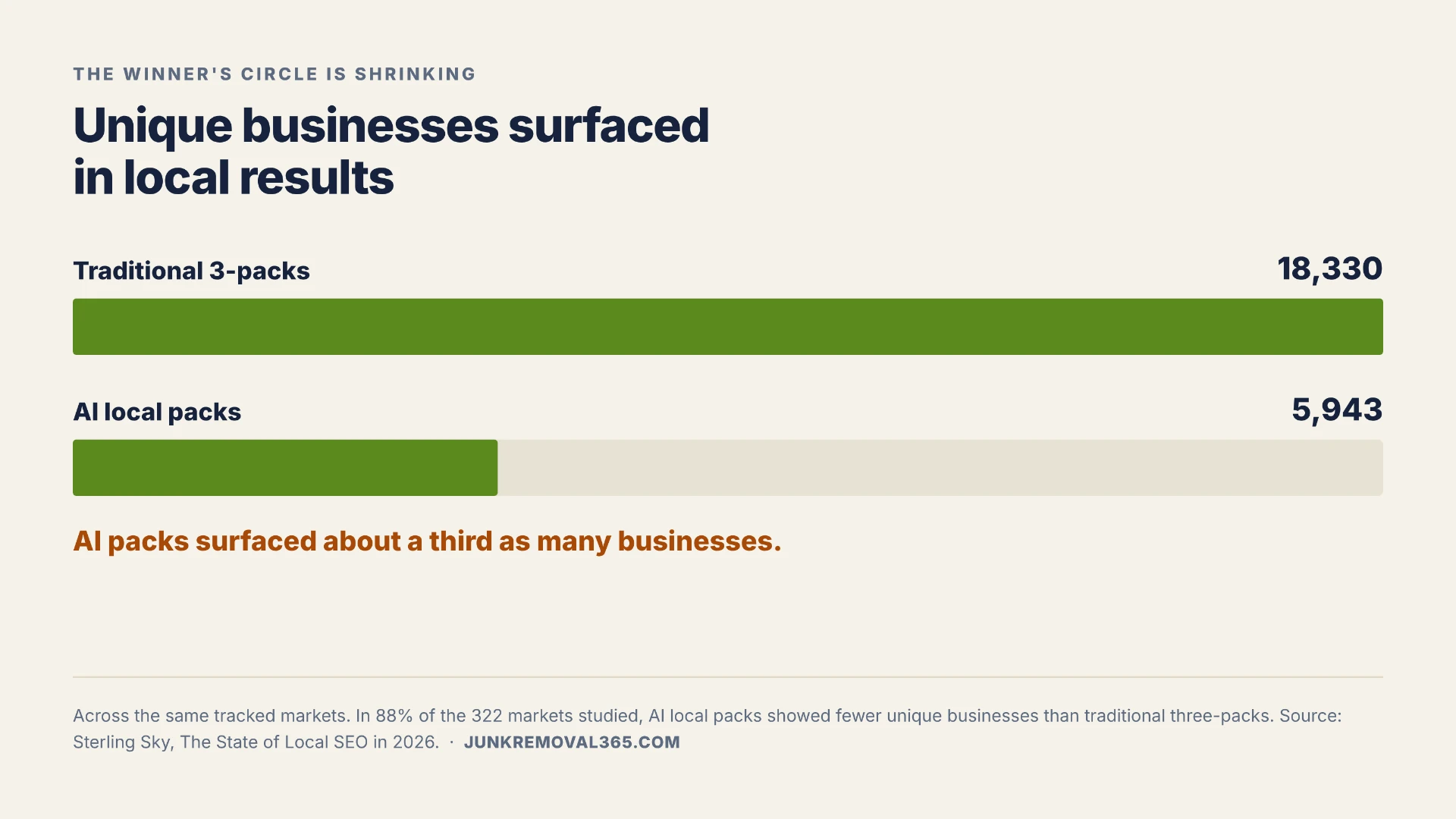
Fewer slots, fewer businesses in them, and no button to tap to call you.
That last point isn’t isolated either. Google has been replacing call buttons with images in several industries — Sterling Sky documented it in handyman local packs between October and November 2025, after an earlier rollout for dentists. Separately, analysis by Jepto across 179 Google Business Profiles for 34 US law firms found clicks-to-call declining over two years, while website clicks from those same profiles held steadier. The drop was concentrated on mobile, where the phone icon is the main action.
If your Google Business Profile has been a major source of calls, that’s the trend line to pay attention to.
4. Paid results are taking the space that’s left
While the organic real estate shrinks, the paid real estate expands.
In Sterling Sky’s tracking, ads inside the local pack went from appearing on about 1% of mobile reports in early 2025 to about 22% by December 2025. Local Services Ads went from about 11% of tracked queries in early 2025 to about 31% by November 2025.
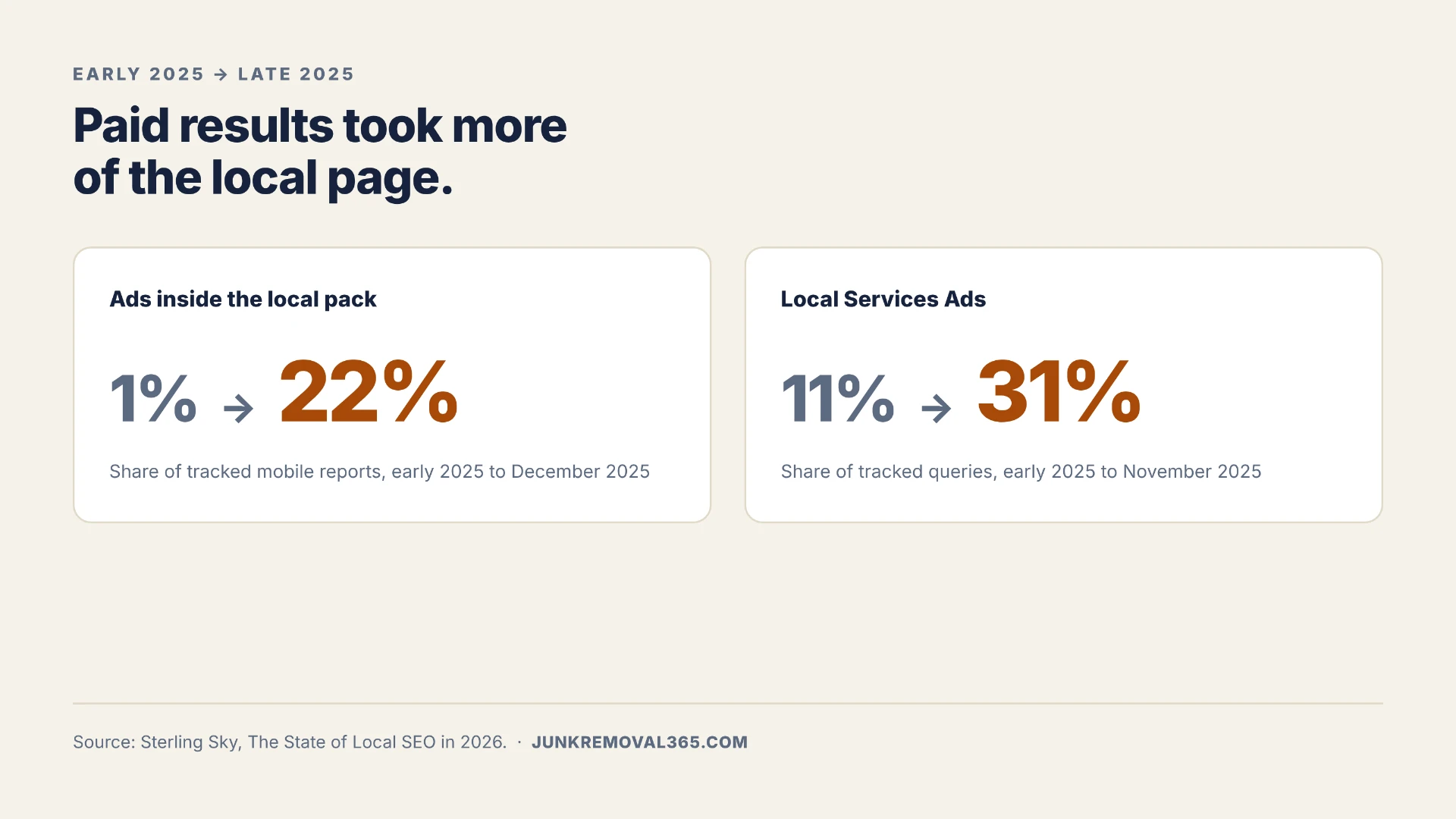
So on a growing share of local searches, the first things a homeowner sees are paid. That’s not a conspiracy, it’s a business model. But it does change the arithmetic on “I’ll just do SEO instead of paying for ads.”
5. Google kept changing the rules on top of all that
2026 has been a busy year for algorithm updates. A Discover update began February 5. A spam update ran March 24–25. A core update ran from March 27 to April 8, then a second core update began May 21 and finished about twelve days later. Three more spam updates followed, beginning June 24, August 18 and September 24.
Google’s guidance was the guidance it usually gives: focus on helpful, reliable, people-first content. There was no new technical lever to pull. If you dropped during one of those windows, there is no single switch guaranteed to reverse it — and if you held steady, that is worth knowing too.
What this adds up to
The old model was: write pages, rank pages, get clicks, get calls.
The new model is closer to: be the thing the answer is made of.
When someone asks ChatGPT or Google’s AI “who should I call to clear out my garage in Tulsa,” the system isn’t ranking ten blue links. It’s assembling an answer from sources it already trusts. And there’s data on which sources those are.
Peec AI analysed 30 million sources cited across ChatGPT, Google AI Mode, Gemini, Perplexity and AI Overviews. Reddit was the most-cited domain overall, followed by YouTube and LinkedIn, with Wikipedia and Forbes rounding out the top five. For recommendation-type queries specifically — the “who should I hire” questions — review and listing platforms such as Yelp appeared frequently, and Google’s AI products leaned toward platforms including Facebook and Yelp.
Notice what isn’t prominent on that list: the average local company website.
That isn’t a reason to neglect your site. It’s a reason to understand what your site is now for. It’s the thing that confirms you’re real once someone’s already heard your name. The hearing-your-name part increasingly happens somewhere else.
What still works
None of this means SEO is dead. It means the work moved. Here’s where it went, in rough order of return for a small junk removal operation.
Your Google Business Profile is still a major lever. It’s shrinking in some ways and changing shape, but it remains central to local intent. Complete every field. Post real job photos regularly. Fill out services properly. Answer questions on the profile yourself.
Reviews, consistently and forever. A steady trickle of genuine reviews gives prospective customers recent evidence that the business is active and dependable. Ask every satisfied customer, every time, the same day.
Write the thing nobody else has written. Generic content — “5 tips for decluttering” — is exactly what AI Overviews can replace, because it’s already been written ten thousand times. What can’t be replaced is specific, first-hand, local material: what the transfer station in your county actually charges, what a cleanout in your market really costs, photos of a job you did on a street people recognise. That’s the content that still earns a click, because the summary at the top can’t produce it from nowhere.
Be present in more than one place. If recommendation answers are assembled from listing and review platforms, then being findable across several of them is no longer a vanity exercise. Your Google Business Profile, Yelp, Facebook, your industry directories, your chamber of commerce — consistent name, address and phone number across all of them.
Track where traffic is actually coming from. Sterling Sky reported one multi-location client whose ChatGPT referral traffic went from 0.1% of its Google traffic a year earlier to 2% in 2026. Small — about 22% of what Bing sent that client — but measurable and growing. Check your analytics for referrals from chatgpt.com and perplexity.ai. If you’re not looking, you won’t see it start.
Reconsider paid, honestly. If ads and Local Services Ads now occupy more local results, “I don’t do ads” is a strategic position with a cost attached. Worth pricing out rather than ruling out — we broke down what each channel actually costs per booked job in Junk Removal Leads: What Every Channel Actually Costs in 2026.
What to stop paying for
Anyone selling you “guaranteed number one rankings.” Two core updates landed this year with no secret technical switch attached. Nobody controls Google well enough to guarantee that.
Bulk citation blasts to hundreds of junk directories. Consistency across a handful of platforms people actually use beats presence on two hundred nobody has heard of.
Thin blog content produced at volume. That’s the category AI Overviews absorb most easily. Ten generic posts are worth less than one page that only you could have written.
The honest summary
Search didn’t simply get worse for junk removal companies. It got narrower. Fewer results get clicked, fewer businesses appear in the newer AI local packs, and more of the answer gets assembled before anyone reaches a website.
The response isn’t to chase the algorithm. It’s to be genuinely findable in the places these systems draw from, to own the local specifics nobody else can write, and to keep the review flow steady — then measure what’s actually producing calls instead of what’s producing rankings.
Junk Removal 365 is a directory of junk removal companies across the US. If you’re working through the “be present in more than one place” part of this, you can add your company to it and manage your own profile, service areas, photos and customer reviews. Add your business here.
We also publish practical guides for hauler owners — what each lead channel costs per booked job, how to price a job against your dump-fee math, and getting your first ten customers.
Frequently asked questions
Why did my junk removal website lose Google traffic in 2026?
Google now answers more searches on the results page, so a site can keep its rankings while receiving fewer visits. In early 2026, 68.01% of US Google searches ended without a click, and AI Overviews reduced clicks to traditional results when they appeared.
Do AI Overviews reduce clicks to local business websites?
They can, especially for informational searches. Research cited in this article found that click-through rates to listed results fell by nearly 60% when an AI Overview appeared, which affects questions about pricing, accepted items and disposal options.
Is the Google local pack getting smaller?
The newer AI-powered local pack is smaller when it appears. Sterling Sky found that these mobile results often showed one or two businesses instead of three, frequently without call buttons, and surfaced 5,943 unique businesses compared with 18,330 in traditional three-packs.
What still works for junk removal SEO in 2026?
Keep your Google Business Profile complete, earn reviews steadily, publish specific first-hand local information, maintain consistent business details across trusted platforms and track calls and referrals rather than rankings alone. Paid search is also worth evaluating where ads occupy more of the local results.
Sources
- Search Engine Land: Google zero-click searches reach 68% in early 2026 (SparkToro analysis using Similarweb data), June 9, 2026.
- Sterling Sky: The State of Local SEO in 2026, June 26, 2026 (data largely through late 2025).
- Search Engine Land: AI search engines cite Reddit, YouTube and LinkedIn most (Peec AI analysis), March 31, 2026.
- Google Search Status Dashboard: 2026 ranking update history.
- Google: Search’s I/O 2026 updates, May 19, 2026.
- Search Engine Land: Google May 2026 core update rollout is complete.